The six Darśanas — the philosophies
षड्दर्शन
Also written: six darshanas · shad darshana · indian philosophy schools · astika darshana · nyaya vaisheshika samkhya yoga mimamsa vedanta · षड्दर्शन
Darśana means 'a seeing' — a way of viewing the whole. There are six orthodox systems, and they are not six chapters of one doctrine. They are six rival philosophies with different metaphysics, different logics and different accounts of freedom, preserved side by side for two thousand years because the tradition regarded the disagreement itself as valuable.
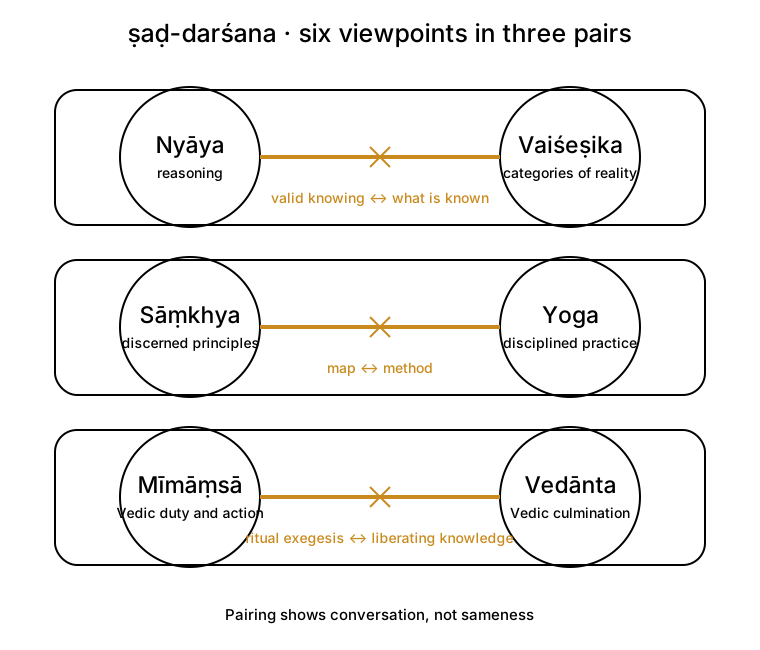
| Darśana | Founder / root text | Central concern | Reality is | Liberation is |
|---|---|---|---|---|
| Nyāya | Gautama — Nyāya Sūtra | Logic and the means of valid knowledge | Plural, real, knowable | Cessation of suffering through true knowledge |
| Vaiśeṣika | Kaṇāda — Vaiśeṣika Sūtra | Categories of being; atomism | Made of eternal atoms in six or seven categories | The self freed from contact with body and mind |
| Sāṅkhya | Kapila — Sāṅkhya Kārikā | Enumeration of the principles of existence | Two: puruṣa (consciousness) and prakṛti (nature) | Kaivalya — the isolation of consciousness from nature |
| Yoga | Patañjali — Yoga Sūtra | The practical stilling of the mind | As in Sāṅkhya, plus Īśvara | Kaivalya, reached by the eight limbs |
| Pūrva Mīmāṁsā | Jaimini — Mīmāṁsā Sūtra | Dharma, and the authority of the Vedic injunction | Real, plural, eternal; the Veda is eternal | Originally heaven by right action; later, release |
| Uttara Mīmāṁsā (Vedānta) | Bādarāyaṇa — Brahma Sūtra | Brahman, the Self, and their relation | Brahman — variously non-dual, qualified, or dual | Knowledge of Brahman; forms vary by school |
What makes a darśana 'orthodox'
Āstika — usually translated 'orthodox' — means only that the school accepts the Veda as a valid means of knowledge. It does not mean belief in God. Sāṅkhya as classically stated has no creator; Pūrva Mīmāṁsā argues that a creator is unnecessary for its purposes; Vaiśeṣika's early form makes little use of one. All three remain āstika. The nāstika schools — Cārvāka, Buddhism and Jainism — are those that decline the Veda's authority, and they were engaged with in argument for two millennia rather than suppressed.
All six begin at the same place
Read the opening lines of the six root texts side by side and a common shape appears. Each begins with a diagnosis — something is wrong — and each promises that a certain kind of knowledge ends it. They differ violently on what that knowledge is knowledge of. They do not differ on the structure of the claim.
प्रमाणप्रमेयसंशयप्रयोजनदृष्टान्तसिद्धान्तावयवतर्कनिर्णयवादजल्पवितण्डाहेत्वाभासच्छलजातिनिग्रहस्थानानां तत्त्वज्ञानान्निःश्रेयसाधिगमः॥
pramāṇa-prameya-saṁśaya-prayojana-dṛṣṭānta-siddhānta-avayava-tarka-nirṇaya-vāda-jalpa-vitaṇḍā-hetvābhāsa-chala-jāti-nigrahasthānānāṁ tattva-jñānān niḥśreyasādhigamaḥ
From true knowledge of the means of knowledge, the knowable, doubt, purpose, example, established doctrine, the members of an argument, hypothetical reasoning, ascertainment, discussion, wrangling, cavil, fallacies of the reason, quibbling, futile rejoinders and the grounds of defeat — from true knowledge of these sixteen comes the attainment of the highest good.
धर्मविशेषप्रसूताद् द्रव्यगुणकर्मसामान्यविशेषसमवायानां पदार्थानां साधर्म्यवैधर्म्याभ्यां तत्त्वज्ञानान्निःश्रेयसम्॥
dharma-viśeṣa-prasūtād dravya-guṇa-karma-sāmānya-viśeṣa-samavāyānāṁ padārthānāṁ sādharmya-vaidharmyābhyāṁ tattva-jñānān niḥśreyasam
The highest good arises from true knowledge — produced by a particular dharma — of the categories substance, quality, action, universality, particularity and inherence, by way of their likenesses and differences.
duḥkha-trayābhighātāj jijñāsā tad-apaghātake hetau dṛṣṭe sāpārthā cen naikānta-atyantato'bhāvāt
From the assault of the threefold suffering arises the desire to know the means of removing it. If it be objected that this enquiry is pointless because visible means already exist — no; for those are neither certain nor final.
हेयं दुःखमनागतम्॥
heyaṁ duḥkham anāgatam
What is to be avoided is the suffering that has not yet come.
अथातो धर्मजिज्ञासा॥
athāto dharma-jijñāsā
Now, therefore, the enquiry into dharma.
अथातो ब्रह्मजिज्ञासा॥
athāto brahma-jijñāsā
Now, therefore, the enquiry into Brahman.
Notice how much is carried by the two small words Jaimini and Bādarāyaṇa share. Atha — 'now' — means the enquirer is qualified and the moment has come; ataḥ — 'therefore' — means something already established makes the enquiry necessary. The commentators spend pages on those two syllables, because they encode a claim about who may philosophise and why. Notice also that Jaimini's object is dharma and Bādarāyaṇa's is Brahman: the two halves of the Veda, the two halves of the Mīmāṁsā, and the fault line along which Indian philosophy eventually split.
The fault lines along which they divide
| Question | Nyāya | Vaiśeṣika | Sāṅkhya | Yoga | Mīmāṁsā | Vedānta |
|---|---|---|---|---|---|---|
| How many pramāṇas? | Four | Two (perception, inference) | Three | Three | Six (Bhāṭṭa) or five (Prābhākara) | Six, following Bhāṭṭa |
| Does the effect pre-exist in the cause? | No — asatkāryavāda | No — ārambhavāda | Yes — satkāryavāda | Yes | No | Yes — as transformation or as appearance |
| Is there an Īśvara? | Yes, an efficient cause | Added by later Vaiśeṣikas | No | Yes, but not as maker | No | Yes — and He is the material cause too |
| What is the self? | A substance with cognition as a quality | One of the nine substances | Pure witnessing consciousness, many | As Sāṅkhya | An eternal agent and enjoyer | Brahman, or a part of it, or eternally distinct from it |
| What is liberation? | Apavarga — the total end of pain | The self freed from all contact | Kaivalya — isolation | Kaivalya | Not originally a goal at all | Knowledge of Brahman |
The row on causation is the deepest of them. If the effect already exists in the cause, then nothing is ever really produced and the universe is an unfolding — Sāṅkhya's position, and with modification Vedānta's. If it does not, then genuinely new things come into being out of a rearrangement of what is eternal — Nyāya-Vaiśeṣika's position, and the reason that school needs atoms and needs a God to set them moving. Almost every other disagreement on this page follows from that one.
Nyāya
The science of reasoning: the sixteen categories, the five-membered syllogism, and the theory of valid knowledge that every other school had to answer.
Vaiśeṣika
Atomism and ontology: the categories of being, the indivisible paramāṇu, and the definition of dharma as what produces both prosperity and the highest good.
Sāṅkhya
The enumeration: puruṣa and prakṛti, the three guṇas, and the twenty-five tattvas from which everything unfolds.
Yoga
Patañjali's 196 sūtras: the stilling of the modifications of the mind, and the eight limbs by which it is done.
Pūrva Mīmāṁsā
The philosophy of dharma and of language: injunction, apūrva, and the eternality of the Vedic word.
Vedānta
The enquiry into Brahman: the prasthāna-traya, and the great schools that read it as non-dual, qualified, or dual.
In this section
Nyāya — the science of right reasoning
Gautama's logic: the four means of knowledge, the sixteen categories, the five-membered syllogism, and why every Indian philosophical debate is conducted in Nyāya's vocabulary.
Vaiśeṣika — atoms and the categories of being
Kaṇāda's system: the indivisible atom, the six (later seven) categories of what exists, and the definition of dharma the whole tradition quotes.
Sāṅkhya — the enumeration of the principles
Puruṣa and prakṛti, the three guṇas, and the twenty-five tattvas: the oldest systematic philosophy of India, and the framework almost every other school borrowed.
Yoga — Patañjali's system
The Yoga Sūtra: 196 aphorisms in four pādas, the definition of yoga, the five kleśas, the eight limbs, and the difference between Patañjali's yoga and what the word now means.
Pūrva Mīmāṁsā — the philosophy of dharma and of language
Jaimini's system: injunction as the heart of the Veda, apūrva, the eternality of the word, and the rules of interpretation that the whole tradition — including its legal system — still uses.
Vedānta — the enquiry into Brahman
Uttara Mīmāṁsā: the three foundations, the central question of the relation between Brahman, the self and the world, and the schools that answered it differently.
The schools of Vedānta
Advaita, Viśiṣṭādvaita, Dvaita, Dvaitādvaita, Śuddhādvaita and Acintya-bhedābheda — six readings of the same three texts, what each holds about the world and the soul, and the ācārya behind each.
Creation — as told by each of the six philosophies
Six systems, six different accounts of how the universe comes to be: atomic aggregation, the unfolding of prakṛti, the eternal Veda without a creator, Brahman appearing as the world, and the Ṛgveda's own refusal to settle it.
The nāstika schools — Cārvāka, Buddhism, Jainism
The three systems that decline the Veda's authority, what each holds, and why the orthodox tradition preserved their arguments at full strength instead of erasing them.
Nyāya — the science of right reasoning
Gautama's logic: the four means of knowledge, the sixteen categories, the five-membered syllogism, and why eve…
Vaiśeṣika — atoms and the categories of being
Kaṇāda's system: the indivisible atom, the six (later seven) categories of what exists, and the definition of …
Sāṅkhya — the enumeration of the principles
Puruṣa and prakṛti, the three guṇas, and the twenty-five tattvas: the oldest systematic philosophy of India, a…
Yoga — Patañjali's system
The Yoga Sūtra: 196 aphorisms in four pādas, the definition of yoga, the five kleśas, the eight limbs, and the…
Pūrva Mīmāṁsā — the philosophy of dharma and of language
Jaimini's system: injunction as the heart of the Veda, apūrva, the eternality of the word, and the rules of in…
Vedānta — the enquiry into Brahman
Uttara Mīmāṁsā: the three foundations, the central question of the relation between Brahman, the self and the …
Last revised 2026-08-16. Corrections are welcome — see how this site is written.