The four Āśramas — one life, four dharmas
आश्रम
Also written: ashrama · four stages of life · brahmacharya grihastha vanaprastha sannyasa · आश्रम
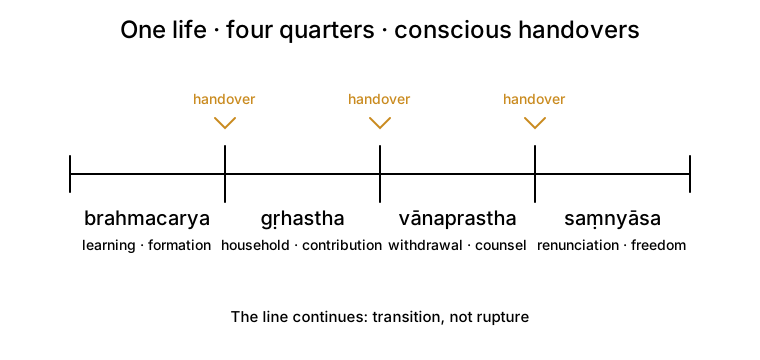
Āśrama comes from ā-śram, 'to exert' — a stage in which a particular kind of effort is appropriate. A human life is divided into four, each with its own svadharma, so that the demands of one age are not carried unchanged into another.
| Āśrama | Roughly | Central work | Dominant aim |
|---|---|---|---|
| Brahmacarya | Birth to ~25 | Study, discipline, the building of capacity and character | Dharma |
| Gṛhastha | ~25 to ~50 | Marriage, family, livelihood, and the support of every other stage | Artha and kāma, within dharma |
| Vānaprastha | ~50 to ~75 | Handing over; withdrawal from acquisition; counsel rather than command | Dharma turning to mokṣa |
| Sannyāsa | ~75 onward | Complete renunciation of role, property and identity | Mokṣa |
The householder carries the rest
यथा नदीनदाः सर्वे सागरे यान्ति संस्थितिम्। तथैवाश्रमिणः सर्वे गृहस्थे यान्ति संस्थितिम्॥
yathā nadī-nadāḥ sarve sāgare yānti saṁsthitim tathaivāśramiṇaḥ sarve gṛhasthe yānti saṁsthitim
As all rivers and streams find their rest in the ocean, so all those in the other stages find their support in the householder.
The student is fed by the householder. The forest-dweller and the renunciate are fed by the householder. The rites of the ancestors are performed by the householder. This is why the tradition, for all its praise of renunciation, calls the gṛhastha āśrama the greatest of the four — and why a young man who wants to skip it is generally told to grow up first.
And yet the sequence is not a cage
Having built a four-stage ladder, the tradition then states — in the Jābāla Upaniṣad, and without apology — that a person who is genuinely ready may step off it at any rung. The condition is not age, and not permission. It is dispassion, and the moment it is real.
यदहरेव विरजेत् तदहरेव प्रव्रजेत्।
yad ahar eva virajet tad ahar eva pravrajet
On whatever day one becomes free of attachment — on that very day let him go forth.
कर्मेन्द्रियाणि संयम्य य आस्ते मनसा स्मरन्। इन्द्रियार्थान्विमूढात्मा मिथ्याचारः स उच्यते॥
karmendriyāṇi saṁyamya ya āste manasā smaran indriyārthān vimūḍhātmā mithyācāraḥ sa ucyate
One who restrains the organs of action while dwelling in mind on the objects of sense — that deluded person is called a hypocrite.
Brahmacarya
Study, restraint, the guru's household, and the conservation of energy for building capacity.
Gṛhastha
Marriage, children, livelihood, hospitality, the five daily yajñas — the productive centre of the whole order.
Vānaprastha
Handing over, reducing possession, and turning attention from acquisition to understanding.
Sannyāsa
The final rite in which one performs one's own funeral, and what is left when every role is set down.
In this section
Brahmacarya — the student stage
The first quarter of life: upanayana, life in the teacher's household, the discipline of study, and the real meaning of brahmacarya.
Gṛhastha — the householder stage
The productive centre of the whole order: marriage, family, livelihood, hospitality, the five great yajñas, and why the tradition calls this stage the greatest.
Vānaprastha — the stage of withdrawal
The third quarter: handing over authority, reducing possession, moving from command to counsel, and preparing the mind for what cannot be prepared for.
Sannyāsa — renunciation
The fourth stage: the rite in which one performs one's own funeral, the four kinds of sannyāsī, the Daśanāmī order, and what renunciation is actually renouncing.
The four Puruṣārthas — what a human life is for
Dharma, artha, kāma and mokṣa: the four legitimate aims of human life, their order, why none may be discarded,…
Dharma as the first aim
Right conduct as the frame within which the other three aims are pursued: the daily obligations, the five debt…
Artha — wealth, means and capability
Why prosperity is a legitimate aim, the Arthaśāstra's treatment of economy and statecraft, and the difference …
Kāma — desire, beauty and delight
Pleasure as a legitimate aim: the Kāma Śāstra tradition, the sixty-four arts, rasa theory, and the single cond…
Mokṣa — liberation
What liberation means, why it is described as the removal of an error rather than the attainment of a place, t…
Brahmacarya — the student stage
The first quarter of life: upanayana, life in the teacher's household, the discipline of study, and the real m…
Last revised 2026-08-16. Corrections are welcome — see how this site is written.