What is Sanātana Dharma
सनातन धर्म
Also written: sanatan dharma · sanatana dharm · sanatan dharm · sanatana dharam · sanathana dharma · sanatan dharam · what is sanatan dharma · meaning of sanatana dharma
Sanātana Dharma is not a faith you adopt. It is the law by which everything that exists is held in being — and it holds you whether you have heard of it or not, exactly as fire burns whether or not it has been told to. Every other page on this site is an unfolding of one sentence: that which exists, exists by doing its own work; and the moment a thing takes up another's work, it begins to come apart.
Sanātana — what 'eternal' is claiming
Sanātana (सनातन) is not a compliment meaning 'very old'. It is a technical claim: without beginning, without end, and without origin in time — therefore not made, therefore not the property of whoever made it. Kṛṣṇa uses the word of the Self itself, and He uses it in a chain of six negations that leave no room for a founding date.
न जायते म्रियते वा कदाचिन्नायं भूत्वा भविता वा न भूयः। अजो नित्यः शाश्वतोऽयं पुराणो न हन्यते हन्यमाने शरीरे॥
na jāyate mriyate vā kadācin nāyaṁ bhūtvā bhavitā vā na bhūyaḥ ajo nityaḥ śāśvato'yaṁ purāṇo na hanyate hanyamāne śarīre
It is never born and never dies; having been, it does not cease to be. Unborn, eternal, everlasting, ancient — it is not slain when the body is slain.
Read the four adjectives in the second line slowly, because they are the definition of sanātana: aja — unborn; nitya — constant; śāśvata — perpetual; purāṇa — ancient without being aged. A thing with those four properties cannot have been founded, cannot be owned, and cannot be lost. And Kṛṣṇa applies the same word to the living being in every body:
ममैवांशो जीवलोके जीवभूतः सनातनः।
mamaivāṁśo jīva-loke jīva-bhūtaḥ sanātanaḥ
An eternal fragment of My own Self, become a living being in the world of the living.
And what is dharma to that eternal reality? Arjuna, seeing the universal form, calls Him not the maker of dharma but its guardian — śāśvata-dharma-goptā. Even the Lord is described as protecting an order rather than inventing one.
त्वमव्ययः शाश्वतधर्मगोप्ता सनातनस्त्वं पुरुषो मतो मे।
tvam avyayaḥ śāśvata-dharma-goptā sanātanas tvaṁ puruṣo mato me
You are the imperishable, the guardian of the everlasting dharma; You, I hold, are the eternal Person.
Dharma — that which holds
Dharma (धर्म) is from the root dhṛ — to hold, to bear, to carry, to sustain. The tradition defines the word by that root and states the definition twice in the Mahābhārata, in almost identical words, once in Bhīṣma's instruction on the bed of arrows.
धारणाद्धर्ममित्याहुर्धर्मेण विधृताः प्रजाः। यः स्याद्धारणसंयुक्तः स धर्म इति निश्चयः॥
dhāraṇād dharmam ity āhur dharmeṇa vidhṛtāḥ prajāḥ yaḥ syād dhāraṇa-saṁyuktaḥ sa dharma iti niścayaḥ
Because it holds, they call it dharma; by dharma all beings are held together. Whatever is joined to holding — that is dharma. This is the settled conclusion.
So dharma is not a rule imposed on a thing from outside. It is the thing's own holding-power — what keeps it being itself. Kaṇāda states the same idea from the other end, by its result: dharma is whatever produces both wellbeing here and the highest good beyond. Neither definition mentions belief, worship, a founder or a community. Both describe a function.
यतोऽभ्युदयनिःश्रेयससिद्धिः स धर्मः।
yato'bhyudaya-niḥśreyasa-siddhiḥ sa dharmaḥ
That from which arises prosperity here and the highest good hereafter — that is dharma.
First, look at the body you are sitting in
Before any doctrine, look at one fact. The eye was made for seeing. Seeing is its dharma — its holding-work, the thing that keeps it an eye. The eye cannot eat. The eye cannot hear. Bring the finest food to the eye and the eye starves; play the finest music to the eye and the eye hears nothing. It has one work.
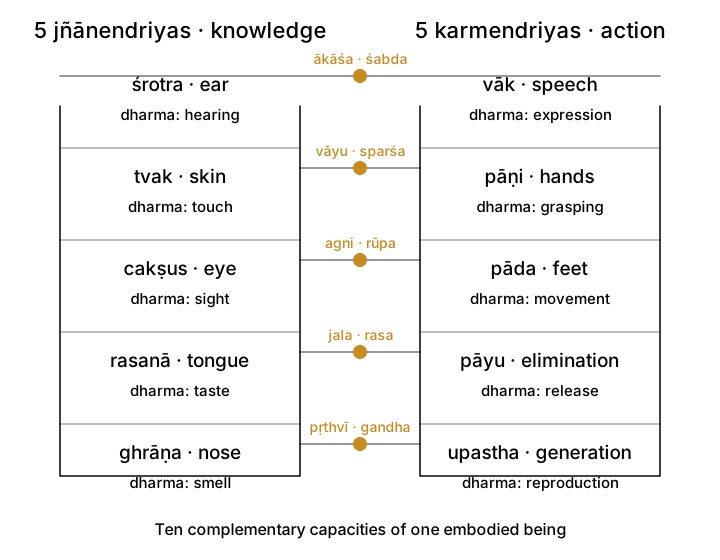
The ear was made for hearing. That is its dharma. It cannot see, and it cannot eat. The tongue tastes and speaks; it does not see. The nose smells; it cannot grasp. The hand grasps; it cannot smell. Not one of these organs is superior to another. Not one of them can take another's position, even for a moment, even if it tried with all its strength. And precisely because each one keeps to its own single work, the whole body functions as one unit of existence.
The instruments, and their fixed subjects
The tradition enumerates them exactly. Five jñānendriyas — organs by which one knows — each locked to a single kind of subject, and each rooted in one of the five elements. And five karmendriyas — organs by which one acts — each with one function.
| Indriya | Organ | Its dharma (subject) | Element | Not its work |
|---|---|---|---|---|
| Śrotra (श्रोत्र) | Ear | Śabda — sound, hearing | Ākāśa | Cannot see, taste, smell or touch |
| Tvak (त्वक्) | Skin | Sparśa — touch, contact | Vāyu | Cannot hear, see, taste or smell |
| Cakṣus (चक्षुस्) | Eye | Rūpa — form, colour, seeing | Agni | Cannot hear, taste, smell or touch |
| Rasanā (रसना) | Tongue | Rasa — taste | Jala | Cannot see, hear, smell |
| Ghrāṇa (घ्राण) | Nose | Gandha — smell | Pṛthivī | Cannot see, hear, taste |
| Indriya | Organ | Its dharma (function) |
|---|---|---|
| Vāk (वाक्) | Speech | Vacana — to speak, to utter |
| Pāṇi (पाणि) | Hands | Ādāna — to grasp, to give and take, to make |
| Pāda (पाद) | Feet | Gamana — to move, to carry the body |
| Pāyu (पायु) | Organ of elimination | Visarga — to release, to let go of what is spent |
| Upastha (उपस्थ) | Organ of generation | Ānanda / prajanana — delight and continuance of life |
The Kaṭha Upaniṣad puts the whole apparatus into one image, and it is the image the tradition has used ever since. Understand it and you understand what the senses are for and what they are not for.
आत्मानं रथिनं विद्धि शरीरं रथमेव तु। बुद्धिं तु सारथिं विद्धि मनः प्रग्रहमेव च॥ इन्द्रियाणि हयानाहुर्विषयांस्तेषु गोचरान्।
ātmānaṁ rathinaṁ viddhi śarīraṁ ratham eva tu buddhiṁ tu sārathiṁ viddhi manaḥ pragraham eva ca indriyāṇi hayān āhur viṣayāṁs teṣu gocarān
Know the Self as the rider in the chariot, and the body as the chariot. Know the intellect as the charioteer, and the mind as the reins. The senses, they say, are the horses; the objects of sense are the roads on which they run.
Every horse is a good horse — at pulling. No horse is asked to drive. No horse is asked to be the passenger. A horse that decided to take the reins would wreck the chariot, and it would not thereby become a charioteer. The Upaniṣad is describing the same law: each part is excellent in its own function and catastrophic outside it.
The Gītā then gives the order of authority in the chariot, so that nobody mistakes the horses for the master.
इन्द्रियाणि पराण्याहुरिन्द्रियेभ्यः परं मनः। मनसस्तु परा बुद्धिर्यो बुद्धेः परतस्तु सः॥
indriyāṇi parāṇy āhur indriyebhyaḥ paraṁ manaḥ manasas tu parā buddhir yo buddheḥ paratas tu saḥ
The senses are said to be higher than the body; higher than the senses is the mind; higher than the mind is the intellect; and higher even than the intellect is He.
And the Kaṭha explains why almost nobody notices any of this: the openings were bored outward. The senses face out by construction, so attention runs out through them by default, and turning it back is against the grain of the instrument.
पराञ्चि खानि व्यतृणत्स्वयम्भूस्तस्मात्पराङ्पश्यति नान्तरात्मन्। कश्चिद्धीरः प्रत्यगात्मानमैक्षदावृत्तचक्षुरमृतत्वमिच्छन्॥
parāñci khāni vyatṛṇat svayambhūs tasmāt parāṅ paśyati nāntarātman kaścid dhīraḥ pratyag-ātmānam aikṣad āvṛtta-cakṣur amṛtatvam icchan
The Self-existent pierced the openings outward; therefore one looks outward and not into the Self within. Some rare wise one, desiring immortality, turned his eyes around and saw the inner Self.
Svadharma — and why another's is called fearful
Now the law can be stated for a person, and Kṛṣṇa states it twice in identical words — a repetition the Gītā almost never allows itself. Whatever is repeated in that book verbatim is being underlined.
श्रेयान्स्वधर्मो विगुणः परधर्मात्स्वनुष्ठितात्। स्वधर्मे निधनं श्रेयः परधर्मो भयावहः॥
śreyān sva-dharmo viguṇaḥ para-dharmāt sv-anuṣṭhitāt sva-dharme nidhanaṁ śreyaḥ para-dharmo bhayāvahaḥ
Better one's own dharma, though imperfectly done, than another's dharma well performed. Better to die in one's own dharma; another's dharma brings fear.
Notice how extreme the statement is. Not 'your own dharma is preferable'. Your own dharma done BADLY outranks another's done WELL — and death inside your own outranks success inside another's. No moral teacher talks like this unless he is describing a structural fact rather than giving advice. And he is. Return to the eye.
Then the second statement, in the final chapter, which supplies the reason the first only asserted:
श्रेयान्स्वधर्मो विगुणः परधर्मात्स्वनुष्ठितात्। स्वभावनियतं कर्म कुर्वन्नाप्नोति किल्बिषम्॥
śreyān sva-dharmo viguṇaḥ para-dharmāt sv-anuṣṭhitāt svabhāva-niyataṁ karma kurvan nāpnoti kilbiṣam
Better one's own dharma, though deficient, than another's well performed. Doing the work determined by one's own nature, one incurs no fault.
Svabhāva-niyataṁ karma — 'work fixed by one's own nature'. Work that flows from your nature cannot stain you, because you are not straining against yourself to do it. Work borrowed from another nature stains even when it succeeds, because it is held up by force, and force has a finite lifespan.
This is why Arjuna's despair is not a moral crisis at all. It is a svadharma crisis: a kṣatriya, standing on a battlefield, proposing to take up the dharma of a mendicant. Kṛṣṇa does not praise the impulse. He calls it a wavering, and tells him plainly that for one of his nature there is no greater good than this.
स्वधर्ममपि चावेक्ष्य न विकम्पितुमर्हसि। धर्म्याद्धि युद्धाच्छ्रेयोऽन्यत्क्षत्रियस्य न विद्यते॥
sva-dharmam api cāvekṣya na vikampitum arhasi dharmyād dhi yuddhāc chreyo'nyat kṣatriyasya na vidyate
Looking to your own dharma, you ought not to waver; for there is nothing better for a kṣatriya than a righteous conflict.
And then the crown of the whole doctrine, in chapter eighteen — the two verses that answer the obvious objection. If everyone simply does their own small work, how does anyone reach the highest? Kṛṣṇa's answer is that the work itself is the worship. Not work abandoned for worship. Not worship added on top of work. The work, offered.
स्वे स्वे कर्मण्यभिरतः संसिद्धिं लभते नरः।
sve sve karmaṇy abhirataḥ saṁsiddhiṁ labhate naraḥ
Devoted each to his own work, a person attains perfection.
यतः प्रवृत्तिर्भूतानां येन सर्वमिदं ततम्। स्वकर्मणा तमभ्यर्च्य सिद्धिं विन्दति मानवः॥
yataḥ pravṛttir bhūtānāṁ yena sarvam idaṁ tatam sva-karmaṇā tam abhyarcya siddhiṁ vindati mānavaḥ
He from whom all beings arise, by whom all this is pervaded — worshipping Him BY ONE'S OWN WORK, a person finds perfection.
The same law in society: the body of the whole
What is true of one body is true of the collective body — and the Veda says so in the most famous and the most misused hymn in the corpus. Before the verse everyone quotes, read the two that set it up, because they decide what it means.
सहस्रशीर्षा पुरुषः सहस्राक्षः सहस्रपात्। स भूमिं विश्वतो वृत्वात्यतिष्ठद्दशाङ्गुलम्॥
sahasra-śīrṣā puruṣaḥ sahasrākṣaḥ sahasra-pāt sa bhūmiṁ viśvato vṛtvātyatiṣṭhad daśāṅgulam
The Puruṣa has a thousand heads, a thousand eyes, a thousand feet. Pervading the earth on every side, He extends beyond it by ten fingers' breadth.
पुरुष एवेदं सर्वं यद्भूतं यच्च भव्यम्।
puruṣa evedaṁ sarvaṁ yad bhūtaṁ yac ca bhavyam
The Puruṣa alone is all this — whatever has been and whatever is to be.
ब्राह्मणोऽस्य मुखमासीद् बाहू राजन्यः कृतः। ऊरू तदस्य यद्वैश्यः पद्भ्यां शूद्रो अजायत॥
brāhmaṇo'sya mukham āsīd bāhū rājanyaḥ kṛtaḥ ūrū tad asya yad vaiśyaḥ padbhyāṁ śūdro ajāyata
The brāhmaṇa was his mouth; of his arms was the kṣatriya made; his thighs became the vaiśya; from his feet the śūdra was born.
And the Gītā supplies the formula that governs every such statement in the tradition: the reality is undivided, and only appears divided among beings. Division of function, not division of substance.
अविभक्तं च भूतेषु विभक्तमिव च स्थितम्। भूतभर्तृ च तज्ज्ञेयं ग्रसिष्णु प्रभविष्णु च॥
avibhaktaṁ ca bhūteṣu vibhaktam iva ca sthitam bhūta-bhartṛ ca taj jñeyaṁ grasiṣṇu prabhaviṣṇu ca
Undivided, yet it abides among beings as though divided. It is to be known as the sustainer of beings, their devourer and their producer.
लोकानां तु विवृद्ध्यर्थं मुखबाहूरुपादतः। ब्राह्मणं क्षत्रियं वैश्यं शूद्रं च निरवर्तयत्॥
lokānāṁ tu vivṛddhy-arthaṁ mukha-bāhūru-pādataḥ brāhmaṇaṁ kṣatriyaṁ vaiśyaṁ śūdraṁ ca niravartayat
For the growth of the worlds, from mouth, arms, thighs and feet he brought forth the brāhmaṇa, the kṣatriya, the vaiśya and the śūdra.
| Part of the body | Varṇa | Its dharma | What fails without it |
|---|---|---|---|
| Mukha — head, mouth | Brāhmaṇa | To know, to teach, to remember, to keep truth and to counsel | The body acts without knowing; memory and direction are lost |
| Bāhu — arms, shoulders | Kṣatriya | To protect, to govern, to bear responsibility, to enforce right | Nothing is defended; the strong devour the weak |
| Udara / ūru — the stomach and middle | Vaiśya | To produce, to nourish, to trade, to circulate wealth and food | Nothing is digested or distributed; all parts starve |
| Pāda — legs and feet | Śūdra | To bear the whole and move it; service, craft, labour, the ground of all | Nothing stands or moves at all — the whole body falls |
Varṇa is by nature and action — never by birth
This is the point on which almost everything is misunderstood. Kṛṣṇa states the criterion Himself, and it is not family, not lineage, and not surname. It is guṇa (inherent quality) and karma (the work one actually does).
चातुर्वर्ण्यं मया सृष्टं गुणकर्मविभागशः। तस्य कर्तारमपि मां विद्ध्यकर्तारमव्ययम्॥
cātur-varṇyaṁ mayā sṛṣṭaṁ guṇa-karma-vibhāgaśaḥ tasya kartāram api māṁ viddhy akartāram avyayam
The fourfold order was created by Me according to the division of quality and action. Though I am its author, know Me as the non-doer, changeless.
Guṇa-karma-vibhāgaśaḥ — 'by the division of quality and work'. Not janma-vibhāgaśaḥ, 'by the division of birth'. Had birth been the criterion, the verse would have said so; it does not. Every human being is born carrying a temperament, and that temperament is the varṇa.
Kṛṣṇa says it again in chapter eighteen, and this time he names the mechanism outright. The works are apportioned by the guṇas born of one's own nature — svabhāva-prabhavair guṇaiḥ. Not by the father's nature. By one's own.
ब्राह्मणक्षत्रियविशां शूद्राणां च परन्तप। कर्माणि प्रविभक्तानि स्वभावप्रभवैर्गुणैः॥
brāhmaṇa-kṣatriya-viśāṁ śūdrāṇāṁ ca parantapa karmāṇi pravibhaktāni svabhāva-prabhavair guṇaiḥ
The works of brāhmaṇas, kṣatriyas, vaiśyas and śūdras are distributed according to the qualities born of their own nature, O scorcher of foes.
| Varṇa — वर्ण | Jāti — जाति |
|---|---|
| Inherent temperament, present from birth in the person | Community one is born into, present in the family record |
| Determined by guṇa and karma — quality and work | Determined by parentage |
| Four, everywhere, in every people and every land | Thousands, regional, historically shifting |
| Can differ between a father and his own son | Identical between father and son by definition |
| What Gītā 4.13 and the Puruṣa Sūkta describe | What the modern word 'caste' actually refers to |
| Recognised by conduct — this is testable | Recognised by paperwork |
The śāstra itself repeatedly overrules birth. Vyāsa, who arranged the Vedas, was the son of a fisherwoman. Vālmīki, author of the Rāmāyaṇa, was a hunter. Viśvāmitra was born a king and became a ṛṣi. In the Chāndogya Upaniṣad, Satyakāma Jābāla does not know his father's name; his teacher accepts him as a brāhmaṇa because he told the truth. Truthfulness, not lineage, made the decision.
न वै एतत् अब्राह्मणो विवक्तुम् अर्हति।
na vai etat abrāhmaṇo vivaktum arhati
'None but a brāhmaṇa could speak thus' — Hāridrumata Gautama, accepting Satyakāma as a student because he spoke the truth about his unknown parentage.
But the sharpest statement in the whole tradition is not in a law book at all. It is in the Mahābhārata, spoken by Yudhiṣṭhira — the embodiment of dharma himself — when the serpent Nahuṣa asks him point-blank who a brāhmaṇa is. Yudhiṣṭhira does not answer with a lineage. He answers with a list of qualities, and then he draws the conclusion that follows from it with brutal directness.
सत्यं दानं क्षमा शीलमानृशंस्यं तपो घृणा। दृश्यन्ते यत्र नागेन्द्र स ब्राह्मणः इति स्मृतः॥
satyaṁ dānaṁ kṣamā śīlam ānṛśaṁsyaṁ tapo ghṛṇā dṛśyante yatra nāgendra sa brāhmaṇa iti smṛtaḥ
Truth, giving, forgiveness, good conduct, absence of cruelty, austerity and compassion — in whomever these are seen, O king of serpents, he is remembered as a brāhmaṇa.
शूद्रे तु यद्भवेल्लक्ष्म द्विजे तच्च न विद्यते। न वै शूद्रो भवेच्छूद्रो ब्राह्मणो न च ब्राह्मणः॥
śūdre tu yad bhavel lakṣma dvije tac ca na vidyate na vai śūdro bhavec chūdro brāhmaṇo na ca brāhmaṇaḥ
If the marks are found in the śūdra, and are NOT found in the twice-born — then that śūdra is not a śūdra, and that brāhmaṇa is not a brāhmaṇa.
An entire Upaniṣad exists on this single question. The Vajrasūcikā Upaniṣad asks 'who, then, is a brāhmaṇa?' and eliminates every candidate in turn — not the living being, not the body, not birth, not learning, not ritual action, not piety — before giving its answer.
Its method is elimination. It asks in turn whether the brāhmaṇa is the living being, the body, birth, knowledge, ritual action, or piety — and rejects each with a reason. If it were the body, it says, then all human bodies being of the same five elements, the distinction would not hold. If it were birth, then the many ṛṣis born outside brāhmaṇa lineages could not be what the tradition plainly calls them. What remains, and what the text settles on, is the direct realisation of the non-dual Self — which it describes with the compound jāti-guṇa-kriyā-hīna, "free of birth, quality and action". He who has realised That, it concludes, he alone is a brāhmaṇa.
The four temperaments are written into the sky
The same fourfold division appears in the nakṣatras. There are twenty-eight nakṣatras, and they fall into four groups of seven — one group for each varṇa temperament. A person born under a nakṣatra carries the traits of its group. This is the astronomical statement of the same law: the fourfold nature is not a human invention layered onto society, it is present in the order of the heavens.
It is for everyone — and everything
Sanātana Dharma is not the property of one people, and not even the property of one species. It governs the human being, the bird, the animal, the tree, the river and the star equally — because it is not a message that had to be delivered to them. It is how existence works.
Anyone who has kept animals knows they carry temperaments no one taught them. Within one litter, one pup places itself between the house and a stranger; one hunts; one herds; one wants only to be near people. In a herd there is one who leads and takes the risk first. In a hive there are foragers, nurses, builders and guards, and no meeting was held to allocate the roles. The four natures are visible in them as plainly as in us — and not one of those creatures was converted, instructed, or given a book.
The Gītā places every womb in the same account. Whatever forms arise, in whatever species — one mother, one father, no exceptions and no hierarchy of origin.
सर्वयोनिषु कौन्तेय मूर्तयः सम्भवन्ति याः। तासां ब्रह्म महद्योनिरहं बीजप्रदः पिता॥
sarva-yoniṣu kaunteya mūrtayaḥ sambhavanti yāḥ tāsāṁ brahma mahad yonir ahaṁ bīja-pradaḥ pitā
Whatever forms arise in all the wombs, O son of Kuntī — the great Brahman is their womb, and I am the seed-giving father.
The sun does not ask
Now take the plainest demonstration available, and the one anyone on earth can check this morning. The sun gives light and heat to everyone. It gives to the temple and to the slaughterhouse, to the devout and the indifferent, to a Hindu, a Muslim, a Christian, an atheist, a crow, a snake and a stone. It does not enquire first. It could not enquire even if it wished to — giving is what it IS. Withdraw the giving and there is no sun left, only a cold rock.
The moon gives an entirely different energy: cooling instead of burning, reflective instead of radiant, governing water, sap, tide and mind. It too gives without asking. And both are required. Sunlight alone scorches the field; moisture alone rots it. Neither one sustains life; the two together do.
Kṛṣṇa claims both, in two consecutive verses — and the second one uses the verb that the word dharma is built from.
यदादित्यगतं तेजो जगद्भासयतेऽखिलम्। यच्चन्द्रमसि यच्चाग्नौ तत्तेजो विद्धि मामकम्॥
yad āditya-gataṁ tejo jagad bhāsayate'khilam yac candramasi yac cāgnau tat tejo viddhi māmakam
The light that resides in the sun and illumines the whole world, and that which is in the moon and in fire — know that light to be Mine.
गामाविश्य च भूतानि धारयाम्यहमोजसा। पुष्णामि चौषधीः सर्वाः सोमो भूत्वा रसात्मकः॥
gām āviśya ca bhūtāni dhārayāmy aham ojasā puṣṇāmi cauṣadhīḥ sarvāḥ somo bhūtvā rasātmakaḥ
Entering the earth, I HOLD all beings by My energy; and becoming the moon, whose very nature is sap, I nourish all the plants.
And notice what the sun and moon never do. The sun does not attempt to rule the night. The moon does not attempt to burn the noon. Neither one campaigns for the other's arena, neither claims the other's function is inferior, and neither withdraws in resentment at having been given the smaller share. Each keeps its own work — and by that restraint alone, the day and the night and the seasons and the harvest and every life that depends on them continue.
Take the sun and the moon out of their own dharma for a single day, and there is no one left alive to argue about which of them was greater.
So a human quarrel over whose function ranks higher is not merely unkind. It is a category error that the sky refutes every twelve hours. And the Gītā draws the human conclusion in the flattest possible terms — the same in all beings, no one hated, no one favoured:
समोऽहं सर्वभूतेषु न मे द्वेष्योऽस्ति न प्रियः।
samo'haṁ sarva-bhūteṣu na me dveṣyo'sti na priyaḥ
I am the same in all beings; there is none hateful to Me and none dear.
And then the verse that makes the point impossible to soften. It names the widest span the ancient world could imagine — a learned brāhmaṇa, a cow, an elephant, a dog, and an outcaste — and calls them one sight to the one who actually sees.
विद्याविनयसम्पन्ने ब्राह्मणे गवि हस्तिनि। शुनि चैव श्वपाके च पण्डिताः समदर्शिनः॥
vidyā-vinaya-sampanne brāhmaṇe gavi hastini śuni caiva śvapāke ca paṇḍitāḥ sama-darśinaḥ
In a brāhmaṇa endowed with learning and humility, in a cow, in an elephant, in a dog, and in an outcaste — the wise see the same.
सर्वभूतस्थमात्मानं सर्वभूतानि चात्मनि। ईक्षते योगयुक्तात्मा सर्वत्र समदर्शनः॥
sarva-bhūta-stham ātmānaṁ sarva-bhūtāni cātmani īkṣate yoga-yuktātmā sarvatra sama-darśanaḥ
One whose self is joined in yoga sees the Self residing in all beings, and all beings in the Self — seeing the same everywhere.
The Veda's own daily prayer asks for exactly that gaze — that all beings look upon me, and I upon all beings, with the eye of a friend.
मित्रस्य मा चक्षुषा सर्वाणि भूतानि समीक्षन्ताम्। मित्रस्याहं चक्षुषा सर्वाणि भूतानि समीक्षे। मित्रस्य चक्षुषा समीक्षामहे॥
mitrasya mā cakṣuṣā sarvāṇi bhūtāni samīkṣantām mitrasyāhaṁ cakṣuṣā sarvāṇi bhūtāni samīkṣe mitrasya cakṣuṣā samīkṣāmahe
May all beings look upon me with the eye of a friend. May I look upon all beings with the eye of a friend. May we look upon one another with the eye of a friend.
This is why the tradition can say, without any strain, that truth is one though the wise speak of it in many ways — and that the whole earth is one family.
एकं सद्विप्रा बहुधा वदन्ति।
ekaṁ sad viprā bahudhā vadanti
That which IS, is One; the wise speak of it in many ways.
अयं निजः परो वेति गणना लघुचेतसाम्। उदारचरितानां तु वसुधैव कुटुम्बकम्॥
ayaṁ nijaḥ paro veti gaṇanā laghu-cetasām udāra-caritānāṁ tu vasudhaiva kuṭumbakam
'This one is mine, that one is a stranger' — so calculate the small-minded. For those of noble conduct, the whole earth is one family.
Macrocosm and microcosm — piṇḍa and brahmāṇḍa
The reason the body could be used as the model for the whole is that the tradition holds them to be built on one pattern. Yat piṇḍe tat brahmāṇḍe — whatever is in this body is in the cosmos; whatever is in the cosmos is in this body. The sun of the sky corresponds to the fire of digestion and the right breath; the moon to the cooling lunar current and the mind; the five elements outside are the five elements within. Studying one is studying the other.
यत्पिण्डे तद्ब्रह्माण्डे।
yat piṇḍe tad brahmāṇḍe
Whatever is in the individual body, that is in the cosmic egg.
Why it is not a cult
A cult requires a founder, an exclusive claim, a boundary of membership, and a penalty for leaving. Sanātana Dharma has none of the four. It has no founder — the ṛṣis are seers who reported what they saw, not proprietors of it. It makes no exclusive claim — it explicitly says truth is one and spoken of in many ways. It has no membership — you do not join gravity. And there is no penalty for leaving, because there is nothing to leave; a person who denies dharma is still being upheld by it, the way a person who denies gravity still falls.
| Sanātana Dharma | A cult or creed |
|---|---|
| No founder; discovered by many seers across ages | One founder, one date |
| No conversion; nothing to join or leave | Membership, initiation, excommunication |
| Applies to animals, plants and stars, not only believers | Applies only to adherents |
| Encourages questioning — the Upaniṣads are almost entirely questions | Discourages questioning |
| Many valid paths and six full philosophical schools, openly disagreeing | One permitted interpretation |
| The goal is direct realisation by the individual | The goal is obedience to the institution |
Where to go from here
The sources of knowledge
Nigama and Āgama, śruti and smṛti, the four Vedas and their six limbs, Itihāsa, Purāṇa and the Sūtras — the entire library and how it fits together.
The four aims of life
Dharma, artha, kāma and mokṣa — what a human life is actually for, and why leaving any one out breaks the other three.
The four stages of life
Brahmacarya, gṛhastha, vānaprastha and sannyāsa — one lifetime read as four dharmas in sequence.
The sixteen refinements
From conception to the final rite — the sixteen saṃskāras, what each one actually does, and why they are performed.
The six philosophies
Nyāya, Vaiśeṣika, Sāṅkhya, Yoga, Mīmāṁsā and Vedānta — six complete systems, and the six different accounts of creation they give.
The living traditions
Śaiva, Śākta, Vaiṣṇava, Gāṇapatya, Saura and Kaumāra — the great streams of worship and their branches.
Dharma — the word, and why it cannot be translated
Dharma is not religion, not morality and not law, though it touches all three. Its root meaning, its ten chara…
Svadharma — your own duty, and why it outranks a better one
The Gītā's central instruction, its two verses, the reasoning behind them, how to recognise your own svadharma…
Varṇa — the four natures, read correctly
What varṇa actually is: a fourfold classification of inherent temperament and work, stated by Kṛṣṇa as guṇa-ka…
The 28 nakṣatras and their four varṇa groups
The twenty-eight nakṣatras fall into four groups of seven, one for each varṇa temperament. The full table, the…
Ṛta — the cosmic order that dharma rests on
Before dharma, the Ṛgveda speaks of ṛta: the impersonal order by which the sun rises, the seasons turn and tru…
Piṇḍa and Brahmāṇḍa — the body and the universe are one pattern
Yat piṇḍe tat brahmāṇḍe — whatever is in this body is in the cosmos. The correspondences of element, breath, s…
Last revised 2026-08-16. Corrections are welcome — see how this site is written.