The 28 nakṣatras and their four varṇa groups
नक्षत्र वर्ण
Also written: nakshatra varna · 28 nakshatras · nakshatra caste · varna of nakshatra · abhijit nakshatra · nakshatra temperament
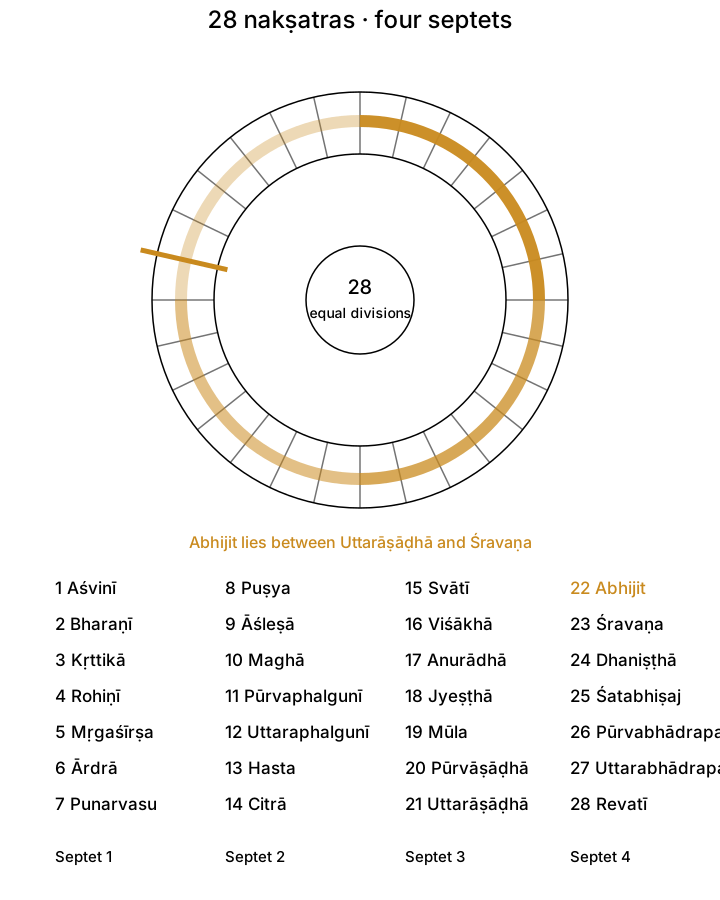
The fourfold nature is not a social invention laid over humanity. It is present in the sky. The twenty-eight nakṣatras — the lunar mansions through which the moon travels — carry varṇa temperaments, and they divide into four groups of seven. A person born under a nakṣatra carries the traits of its group.
Why the moon, and not the sun
The nakṣatras are the moon's road. The sun takes a year to cross the zodiac; the moon crosses it in about twenty-seven and a third days, occupying roughly one nakṣatra a day. So the nakṣatra is the finest-grained marker the sky offers — and because the moon governs the mind in this tradition, the nakṣatra the moon stood in at birth is taken as the marker of temperament rather than of circumstance.
नक्षत्राणामहं शशी।
nakṣatrāṇām ahaṁ śaśī
Among the nakṣatras I am the moon.
The Vedic tradition counted by this road long before it counted by solar months. The Taittirīya Saṁhitā opens its nakṣatra list with Kṛttikā, and the Atharvaveda devotes an entire hymn to the nakṣatras as deities in their own right — each with its presiding power, each with its own character. Temperament read from the sky is therefore not a late astrological accretion; it is present in the Saṁhitās.
चन्द्रमा मनसो जातः।
candramā manaso jātaḥ
From His mind was born the moon.
Twenty-seven, twenty-eight, and the missing seventh
The nakṣatra list is usually given as twenty-seven, because twenty-seven equal divisions of 13°20′ each fill the zodiac exactly. But the older enumeration is twenty-eight, including Abhijit — 'the unconquered' — which sits at the end of Uttarāṣāḍhā and the beginning of Śravaṇa. Abhijit is the nakṣatra of Brahmā, and the classical muhūrta texts never dropped it: the eighth muhūrta of the day still bears its name and remains the most auspicious of the day.
This matters for varṇa. The received varṇa grouping of the twenty-seven gives seven, seven, seven and six. Restore Abhijit as the twenty-eighth and the symmetry is exact: four groups of seven, 4 × 7 = 28.
The four groups
| Varṇa group | The seven nakṣatras | Temperament carried |
|---|---|---|
| Brāhmaṇa / Vipra | Aśvinī · Puṣya · Āśleṣā · Viśākhā · Anurādhā · Śatabhiṣā · Pūrva Bhādrapadā | Turned toward knowing, healing, teaching, ritual and the unseen. Reflective, exacting, drawn to what is hidden; discomfort with crude power and crude gain. |
| Kṣatriya | Bharaṇī · Punarvasu · Maghā · Svātī · Jyeṣṭhā · Dhaniṣṭhā · Uttara Bhādrapadā | Turned toward authority, protection, endurance and command. Carries responsibility naturally, resents being ruled badly, will bear cost for others. |
| Vaiśya | Kṛttikā · Ārdrā · Pūrva Phalgunī · Citrā · Mūla · Śravaṇa · Revatī | Turned toward production, exchange, cultivation and increase. Practical, resourceful, alert to value; makes things grow and circulate. |
| Śūdra | Rohiṇī · Mṛgaśirā · Uttara Phalgunī · Hasta · Pūrvāṣāḍhā · Uttarāṣāḍhā · Abhijit | Turned toward service, craft, skill of hand and support of the whole. Steady, dependable, capable of sustained work that others cannot sustain. |
How to read this without fatalism
A nakṣatra describes an inclination, not a sentence. It tells you which work will feel like your own and which will feel like wearing another man's clothes. That is precisely the use of it — svadharma becomes easier to recognise when you know your own grain. It never licenses ranking one person above another, for the same reason the body-image does not.
| Group | Reads the world through | Natural contribution | Characteristic failure |
|---|---|---|---|
| Brāhmaṇa | Meaning and truth | Clarity, memory, counsel | Detachment that becomes contempt |
| Kṣatriya | Duty and consequence | Protection, decision, courage | Force used where patience was needed |
| Vaiśya | Value and exchange | Abundance, enterprise, supply | Accumulation without purpose |
| Śūdra | Work and belonging | Skill, endurance, loyalty | Endurance that never asks for its due |
Almost nobody is a single pure type. The moon's nakṣatra gives the dominant grain; the ascendant, the sun and the daily svara give others. What the classification is for is recognition — the moment a person sees their own grain clearly, the question 'what is my work?' usually answers itself.
What is Sanātana Dharma
Sanātana Dharma is not a religion, a founder's creed or a cult — it is the eternal natural law by which every …
Dharma — the word, and why it cannot be translated
Dharma is not religion, not morality and not law, though it touches all three. Its root meaning, its ten chara…
Svadharma — your own duty, and why it outranks a better one
The Gītā's central instruction, its two verses, the reasoning behind them, how to recognise your own svadharma…
Varṇa — the four natures, read correctly
What varṇa actually is: a fourfold classification of inherent temperament and work, stated by Kṛṣṇa as guṇa-ka…
Ṛta — the cosmic order that dharma rests on
Before dharma, the Ṛgveda speaks of ṛta: the impersonal order by which the sun rises, the seasons turn and tru…
Piṇḍa and Brahmāṇḍa — the body and the universe are one pattern
Yat piṇḍe tat brahmāṇḍe — whatever is in this body is in the cosmos. The correspondences of element, breath, s…
Last revised 2026-08-16. Corrections are welcome — see how this site is written.