Sāṅkhya — the enumeration of the principles
साङ्ख्य
Also written: samkhya · sankhya · kapila · purusha prakriti · three gunas · 25 tattvas · साङ्ख्य
Sāṅkhya means 'enumeration'. It is probably the oldest of the systems, attributed to Kapila, and its vocabulary — puruṣa, prakṛti, the three guṇas, the tattvas — is used by the Gītā, by Yoga, by Āyurveda, by the Purāṇas and by the Tantras. One can hardly read the tradition without it.
Why enquire at all
duḥkha-trayābhighātāj jijñāsā tad-apaghātake hetau dṛṣṭe sāpārthā cen naikānta-atyantato'bhāvāt
From the assault of the threefold suffering arises the desire to know the means of removing it. If it be said that this enquiry is pointless because visible means already exist — no; for those are neither certain nor final.
The threefold suffering is ādhyātmika, what arises within oneself in body and mind; ādhibhautika, what other beings inflict; ādhidaivika, what comes from causes beyond any creature's control. Against all three there are visible remedies — medicine, walls, precautions — and the objector says so. Īśvarakṛṣṇa's reply is two words long and decides the whole system: ekānta and atyanta. A remedy that is not ekānta may fail; a remedy that is not atyanta will work and then wear off. Philosophy is justified only if it can offer something that is certain and permanent. If it cannot, the physician is a better guide.
The second verse then does something startling for an orthodox school: it applies the same two tests to Vedic sacrifice, and fails it.
dṛṣṭavad ānuśravikaḥ sa hy aviśuddhi-kṣayātiśaya-yuktaḥ tad-viparītaḥ śreyān vyaktāvyakta-jña-vijñānāt
The scriptural means is like the visible one, for it is bound up with impurity, with decay and with degrees. Better than these is its opposite — that which arises from the discriminative knowledge of the manifest, the unmanifest and the knower.
Three charges, precisely aimed. Impurity: sacrifice involves the killing of animals. Decay: the heaven it wins is spent when the merit is spent, and the enjoyer falls back. Degrees: heavens are ranked, and where there is a higher place there is envy, so even the reward is not free of suffering. The alternative Sāṅkhya offers is not another ritual but a discrimination — knowing the manifest, the unmanifest and the knower apart from one another. That triad is the map of the entire system, and the next verse draws it.
mūla-prakṛtir avikṛtir mahad-ādyāḥ prakṛti-vikṛtayaḥ sapta ṣoḍaśakas tu vikāro na prakṛtir na vikṛtiḥ puruṣaḥ
Root-nature is not a modification of anything. The seven beginning with mahat are both producers and products. The set of sixteen is product only. Puruṣa is neither producer nor product.
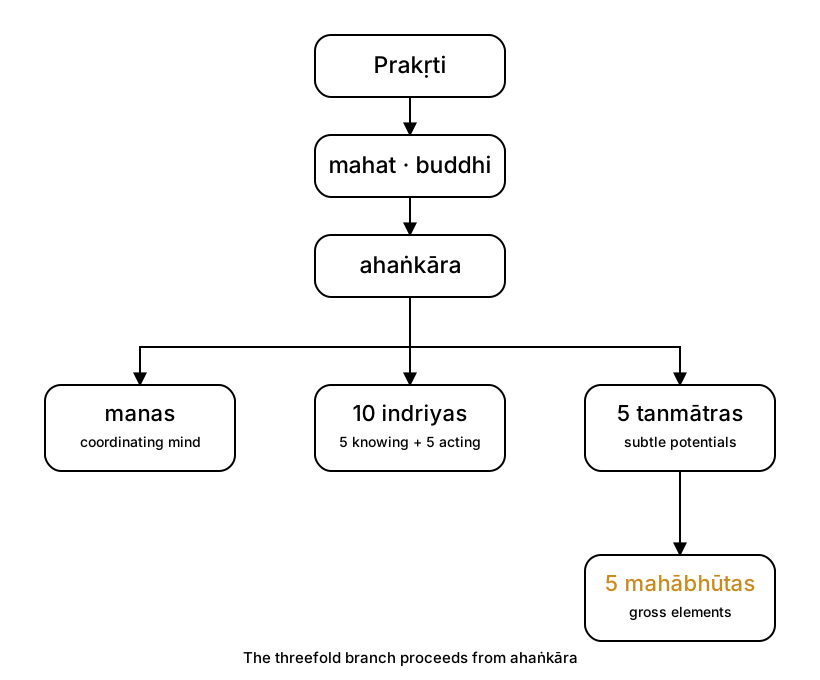
Twenty-five principles sorted by a single criterion — what produces, what is produced, both, neither. Root-nature produces and is not produced. Puruṣa neither produces nor is produced, and that double negation is the technical statement of its absolute freedom from the causal order. In between stand seven that are both, and sixteen that are only ever effects. Nothing in the list is invented for the sake of the scheme; the scheme is what falls out when you ask of each item only whether it makes and whether it is made.
Two irreducibles
| Puruṣa — पुरुष | Prakṛti — प्रकृति | |
|---|---|---|
| What it is | Consciousness, the witness | Nature, the principle of manifestation |
| Active? | Never. It only witnesses | Always. All activity belongs to it |
| Conscious? | It is consciousness itself | Unconscious, though intelligent in its operations |
| Number | Many — each being has its own | One, shared |
| Changes? | Never | Constantly |
tri-guṇam aviveki viṣayaḥ sāmānyam acetanaṁ prasava-dharmi vyaktaṁ tathā pradhānaṁ tad-viparītas tathā ca pumān
The manifest, and likewise the unmanifest ground, are of three guṇas, undiscriminating, objective, common, unconscious and productive. Puruṣa is the reverse of these — and in certain respects like them.
The list works as a definition by contrast, item by item. Nature is triple; puruṣa is without guṇas. Nature does not discriminate; puruṣa is discrimination itself. Nature is an object, available to be known; puruṣa is never an object and can only be the knower. Nature is common — one prakṛti serves all beings; puruṣa is particular to each. Nature is unconscious; puruṣa is consciousness. Nature produces; puruṣa produces nothing. The final phrase saves the argument from absurdity: in being uncaused, eternal, all-pervading and without parts, the two are alike. They are not opposites in every respect, only in the respects that matter.
How Sāṅkhya proves that puruṣa exists
This is the school's central argument and it is a genuine inference, not an appeal to scripture. Five reasons are given in a single verse.
saṅghāta-parārthatvāt tri-guṇādi-viparyayād adhiṣṭhānāt puruṣo'sti bhoktṛ-bhāvāt kaivalyārthaṁ pravṛtteś ca
Puruṣa exists — because every aggregate is for the sake of another; because there must be something opposite to the three guṇas and the rest; because there must be a superintendent; because there must be an enjoyer; and because there is striving toward isolation.
- A bed is an assembly of parts, and assemblies exist for a user who is not himself an assembly. The body, the senses and the mind are assemblies. Therefore there is a user outside the series.
- Everything catalogued so far is three-guṇaed, unconscious and objective. A term is required of which the opposite holds, or the contrast that defines the whole list is empty.
- A chariot cannot go without a driver. The unconscious instruments must be presided over by something that is not itself an instrument.
- Pleasure and pain must be experienced by someone. Nature can present them, but presentation to nobody is not experience.
- Beings strive for release. The striving is intelligible only if there is something that can be released.
Notice how much rests on the first. If a bed exists for a sleeper, and a sleeper is himself a composite of body and mind, then the argument threatens a regress — for whose sake does the sleeper exist? Sāṅkhya's answer is that the regress terminates only at something non-composite, and that is exactly what puruṣa is defined to be. Vedānta accepts this argument and then turns it: if puruṣa is one and non-composite, why are there many? Sāṅkhya's reply is the next verse — beings are born and die at different times, act at different times, and differ in their proportions of the guṇas; if there were one puruṣa, one man's birth would be everyone's birth and one man's liberation would be everyone's. The plurality of consciousnesses is inferred from the plain non-simultaneity of lives.
The lame man and the blind man
The classic image: prakṛti is a dancer and puruṣa the audience. She performs only while watched; when the witness truly sees that he is not the dance, she withdraws. Bondage is the misattribution of prakṛti's activity to puruṣa; kaivalya is the ending of that confusion.
puruṣasya darśanārthaṁ kaivalyārthaṁ tathā pradhānasya paṅgv-andha-vad ubhayor api saṁyogas tat-kṛtaḥ sargaḥ
For the seeing of puruṣa, and for the isolation of the primal ground, the two are joined as the lame man and the blind man are joined; and from that union proceeds creation.
The image is exact, and the exactness is the argument. A lame man who can see and a blind man who can walk are stranded separately in a forest; the lame man rides the blind man's shoulders and directs him, and both get out. Neither acquires the other's faculty — the blind man never sees, the lame man never walks. Their cooperation is entirely a matter of proximity, and it dissolves the moment the forest is crossed. That is precisely the relation Sāṅkhya needs: puruṣa contributes nothing but presence, prakṛti contributes everything but awareness, and no property of either is ever transferred. The union is not a mixture. Which is why the next verse can say that consciousness merely appears where it is not.
tasmāt tat-saṁyogād acetanaṁ cetanāvad iva liṅgam guṇa-kartṛtve ca tathā karteva bhavaty udāsīnaḥ
Therefore, through that union, the unconscious instrument appears as though it were conscious; and although agency belongs to the guṇas, the indifferent one appears as though it were the agent.
Two mistakes, running in opposite directions, and one word governing both: iva, 'as if'. The mind, which is unconscious, seems to be aware — as a mirror seems to be bright. And the witness, which never acts, seems to be the doer. The Gītā states the same doctrine in almost the same terms, which is one reason Sāṅkhya's vocabulary became everyone's.
प्रकृतेः क्रियमाणानि गुणैः कर्माणि सर्वशः। अहंकारविमूढात्मा कर्ताहमिति मन्यते॥
prakṛteḥ kriyamāṇāni guṇaiḥ karmāṇi sarvaśaḥ ahaṅkāra-vimūḍhātmā kartāham iti manyate
Actions are in every case performed by the guṇas of nature. He whose self is deluded by the I-maker thinks: I am the doer.
The three guṇas
| Guṇa | Nature | In the mind | In the world |
|---|---|---|---|
| Sattva | Light, clarity, harmony | Understanding, calm, joy | Transparency, order, intelligence |
| Rajas | Motion, passion, energy | Craving, restlessness, striving | Activity, change, force |
| Tamas | Weight, inertia, concealment | Dullness, confusion, sleep | Mass, resistance, stability |
The three are not good and bad. They are the three modes in which anything whatever appears, always together, always in some proportion. Even sattva binds — the Gītā says it binds by attachment to happiness and to knowledge, which is a subtler chain than the other two.
सत्त्वं रजस्तम इति गुणाः प्रकृतिसम्भवाः। निबध्नन्ति महाबाहो देहे देहिनमव्ययम्॥
sattvaṁ rajas tama iti guṇāḥ prakṛti-sambhavāḥ nibadhnanti mahābāho dehe dehinam avyayam
Sattva, rajas and tamas — the guṇas born of nature — bind fast in the body, O mighty-armed, the imperishable dweller in the body.
Read the last four words against everything Sāṅkhya has said and a contradiction seems to open: the guṇas bind the dweller, yet the dweller is imperishable and never acts. The resolution is the 'as if' of Kārikā 20. What is bound is the subtle apparatus; the binding is attributed to the witness by the same error that attributes agency to him. The Upaniṣads had already put the three under a single image, calling nature an unborn female of three colours — red, white and black, the standard colours of rajas, sattva and tamas.
अजामेकां लोहितशुक्लकृष्णां बह्वीः प्रजाः सृजमानां सरूपाः। अजो ह्येको जुषमाणोऽनुशेते जहात्येनां भुक्तभोगामजोऽन्यः॥
ajām ekāṁ lohita-śukla-kṛṣṇāṁ bahvīḥ prajāḥ sṛjamānāṁ sarūpāḥ ajo hy eko juṣamāṇo'nuśete jahāty enāṁ bhukta-bhogām ajo'nyaḥ
There is one unborn female, red, white and black, bringing forth many creatures like herself. One unborn male lies with her, delighting in her; another unborn male leaves her, her enjoyment spent.
Two unborn males, one identical in nature with the other, differing only in whether he is still absorbed in her. That is bondage and liberation stated as a difference of attention rather than a difference of substance — and it is why Sāṅkhya can say, at the end, that nothing whatever happens to puruṣa when he is freed.
The twenty-five tattvas
| Level | Tattvas |
|---|---|
| 1. Consciousness | Puruṣa |
| 2. The root of nature | Prakṛti (mūla-prakṛti, avyakta — unmanifest) |
| 3. First evolute | Mahat / buddhi — intelligence, the faculty of determination |
| 4. Second | Ahaṅkāra — the I-maker, the sense of being a separate doer |
| 5. Mind | Manas — the coordinating and doubting faculty |
| 6–10. Organs of knowing | Ear, skin, eye, tongue, nose |
| 11–15. Organs of action | Speech, hands, feet, elimination, generation |
| 16–20. Subtle elements | Sound, touch, form, taste, smell (tanmātras) |
| 21–25. Gross elements | Ether, air, fire, water, earth |
The five reasons the effect must already be there
asad-akaraṇād upādāna-grahaṇāt sarva-sambhavābhāvāt śaktasya śakya-karaṇāt kāraṇa-bhāvāc ca sat-kāryam
Because what does not exist cannot be brought into being; because a specific material is resorted to; because everything does not arise from everything; because what is capable produces only what it is capable of; and because the effect has the nature of the cause — the effect pre-exists.
- No agent can produce what is simply non-existent. A thousand artists cannot make blue out of yellow, and no craftsman has ever made a hare's horn.
- A maker goes to a specific material. Curd is sought in milk, oil in sesame. If the effect were not already in that material, any material would do.
- Not everything comes from everything. Gold comes from ore and not from sand. The restriction has to be grounded in the cause.
- A cause produces only what lies within its power, and what lies within its power is what it already contains potentially.
- The effect has the nature of the cause — a cloth is nothing but its threads arranged. Since cause and effect do not differ in substance, and the cause exists, the effect exists.
नासतो विद्यते भावो नाभावो विद्यते सतः।
nāsato vidyate bhāvo nābhāvo vidyate sataḥ
Of the unreal there is no coming to be; of the real there is no ceasing to be.
Nobody is bound, nobody is freed
The system's conclusion is the most counter-intuitive sentence in Indian philosophy, and it follows with complete rigour from everything above. If puruṣa never acts, never changes and is never touched, then puruṣa was never in bondage — and what was never bound cannot be released.
tasmān na badhyate'ddhā na mucyate nāpi saṁsarati kaścit saṁsarati badhyate mucyate ca nānāśrayā prakṛtiḥ
Therefore nobody, truly, is bound; nobody is released; nobody transmigrates. It is nature, resting in manifold supports, that transmigrates, is bound, and is released.
evaṁ tattvābhyāsān nāsmi na me nāham ity apariśeṣam aviparyayād viśuddhaṁ kevalam utpadyate jñānam
Thus, from the repeated practice of the principles, there arises the knowledge 'I am not; nothing is mine; I am not the doer' — leaving no residue, free of error, pure, absolute.
Three denials, and each cancels one of the three misidentifications the system has been dismantling. 'I am not' cancels the sense of being an existent among existents — the work of ahaṅkāra. 'Nothing is mine' cancels ownership of the body, the senses and their objects. 'I am not the doer' cancels agency, which belongs to the guṇas alone. What remains after all three is not a fourth thing that could be said; it is the witness, which was there throughout.
raṅgasya darśayitvā nivartate nartakī yathā nṛtyāt puruṣasya tathātmānaṁ prakāśya vinivartate prakṛtiḥ
As a dancing girl withdraws from the dance once she has shown herself to the audience, so nature withdraws once she has revealed herself to puruṣa.
And the verse that follows says nothing in the system is more delicate than prakṛti: having once been seen, she never comes again into the sight of that puruṣa. The point is technical, not sentimental — the knowledge is irreversible. But the body does not fall away at that moment. Like a potter's wheel that keeps turning after the potter's hand has left it, the momentum of accumulated impressions carries the body on until it is spent. That is Sāṅkhya's account of the liberated person still walking about, and it is the same doctrine Vedānta will call jīvanmukti.
samyag-jñānādhigamād dharmādīnām akāraṇa-prāptau tiṣṭhati saṁskāra-vaśāc cakra-bhramavad dhṛta-śarīraḥ
When, by attaining right knowledge, merit and the rest have lost their power to cause, he yet continues — by the force of past impressions, holding the body, like a wheel that goes on spinning.
What the other schools said against it
- Vedāntathe decisive objection
- An unconscious prakṛti cannot act for a purpose, and Sāṅkhya's whole story is purposive — nature evolves 'for the sake of' puruṣa's seeing. Bādarāyaṇa's sūtras rule out an unconscious first cause on the ground that the Upaniṣads describe the cause as seeing and willing, and Śaṅkara adds that milk flowing for the calf is no parallel, since a cow is conscious. Sāṅkhya replies with the analogy of unconscious milk flowing for the calf's nourishment — and the debate turns on whether teleology without a mind is coherent, which is not a settled question yet.
- Vedānta againon plurality
- If puruṣas are absolutely without qualities, they have nothing by which to differ; distinguishing them requires attributes, and attributes are what puruṣa lacks. Advaita concludes there is one. Sāṅkhya's answer is that the difference is given directly by the non-simultaneity of birth, death and liberation, and needs no distinguishing attribute.
- Nyāyaon causation
- If the effect already exists, production is a word for nothing, and the pot ought to hold water while still in the lump of clay. Sāṅkhya distinguishes existence from manifestation; Nyāya replies that this is precisely the distinction being denied.
- The internal problemthe one Sāṅkhya never solved
- If mere proximity to puruṣa disturbs prakṛti's equilibrium, and puruṣa is always present, why does creation ever end — and why is one man liberated while another is not, since proximity is uniform? Later Sāṅkhya invokes the beginninglessness of the association and the differing ripeness of individual apparatus. The Vedāntins regarded this as the point at which Sāṅkhya needs an Īśvara and refuses to admit one; Patañjali, on the next page, admits one.
The six Darśanas — the philosophies
Nyāya, Vaiśeṣika, Sāṅkhya, Yoga, Pūrva Mīmāṁsā and Vedānta: six complete philosophical systems, each with its …
Nyāya — the science of right reasoning
Gautama's logic: the four means of knowledge, the sixteen categories, the five-membered syllogism, and why eve…
Vaiśeṣika — atoms and the categories of being
Kaṇāda's system: the indivisible atom, the six (later seven) categories of what exists, and the definition of …
Yoga — Patañjali's system
The Yoga Sūtra: 196 aphorisms in four pādas, the definition of yoga, the five kleśas, the eight limbs, and the…
Pūrva Mīmāṁsā — the philosophy of dharma and of language
Jaimini's system: injunction as the heart of the Veda, apūrva, the eternality of the word, and the rules of in…
Vedānta — the enquiry into Brahman
Uttara Mīmāṁsā: the three foundations, the central question of the relation between Brahman, the self and the …
Last revised 2026-08-16. Corrections are welcome — see how this site is written.