Varṇa — the four natures, read correctly
वर्ण
Also written: varna system · varna dharma · chaturvarnya · chaturvarnyam maya srishtam · varna vs caste · is varna caste · brahmin kshatriya vaishya shudra meaning · वर्ण व्यवस्था
Varṇa means 'that by which a thing is distinguished' — a classification of natures. There are four, they exist in every society on earth whether or not it has a word for them, and the śāstra assigns them by quality and conduct. Birth is not the criterion; the confusion of varṇa with birth-group is a later social hardening, and the texts themselves contradict it.
The defining verse
चातुर्वर्ण्यं मया सृष्टं गुणकर्मविभागशः।
cātur-varṇyaṁ mayā sṛṣṭaṁ guṇa-karma-vibhāgaśaḥ
The fourfold order was created by Me by the division of quality and action.
Kṛṣṇa then does something rarely noticed: in chapter 18 he does not define the four by occupation at all, but by the qualities that arise from each nature. Read those four verses and it is obvious that a description of character, not of parentage, is being given.
| Varṇa | Qualities Kṛṣṇa names | Function that follows |
|---|---|---|
| Brāhmaṇa | Śama (calm), dama (restraint), tapas (austerity), śauca (purity), kṣānti (patience), ārjava (straightness), jñāna, vijñāna, āstikya (conviction in the real) | Knowing, teaching, remembering, counselling, keeping the truth |
| Kṣatriya | Śaurya (valour), tejas (radiance), dhṛti (firmness), dākṣya (skill), not fleeing in battle, dāna (giving), īśvara-bhāva (capacity to rule) | Protecting, governing, enforcing, bearing responsibility |
| Vaiśya | Kṛṣi (cultivation), go-rakṣya (care of cattle and resources), vāṇijya (exchange) | Producing, nourishing, circulating wealth, enterprise |
| Śūdra | Paricaryā (service), and — by the same verse — natural work carried out with skill | Supporting, making, labouring, carrying the whole |
The verse that settles it — Śānti Parva 188
In the Mahābhārata, the sage Bharadvāja asks Bhṛgu the question directly: if brāhmaṇa, kṣatriya, vaiśya and śūdra are distinguished by colour, and colours are seen mixed in all of them, how is varṇa determined at all? Bhṛgu's answer is the most explicit statement on the subject anywhere in the corpus.
न विशेषोऽस्ति वर्णानां सर्वं ब्राह्ममिदं जगत्। ब्रह्मणा पूर्वसृष्टं हि कर्मभिर्वर्णतां गतम्॥
na viśeṣo'sti varṇānāṁ sarvaṁ brāhmam idaṁ jagat brahmaṇā pūrva-sṛṣṭaṁ hi karmabhir varṇatāṁ gatam
There is no distinction of varṇas; this whole world is Brahman. Created formerly by Brahmā, it came into the condition of varṇa THROUGH ACTIONS.
The Bhāgavata makes the operational rule out of it. Nārada, instructing Yudhiṣṭhira on the duties of the varṇas, states what to do when the marks and the birth disagree — and the rule is unambiguous: go by the marks.
यस्य यल्लक्षणं प्रोक्तं पुंसो वर्णाभिव्यञ्जकम्। यदन्यत्रापि दृश्येत तत्तेनैव विनिर्दिशेत्॥
yasya yal lakṣaṇaṁ proktaṁ puṁso varṇābhivyañjakam yad anyatrāpi dṛśyeta tat tenaiva vinirdiśet
Whatever characteristic has been described as indicating a person's varṇa — if that characteristic is seen in someone else, then that person should be designated by THAT very characteristic.
Everyone is born śūdra — saṃskāra makes the twice-born
There is a verse quoted everywhere on this subject, and it says exactly what the Gītā says, in one line. It deserves to be given with its correct source, because it is very often attributed to Manu and its attested mūla is elsewhere.
जन्मना जायते शूद्रः संस्कारात् द्विज उच्यते। वेदपाठात् भवेद्विप्रः ब्रह्म जानाति ब्राह्मणः॥
janmanā jāyate śūdraḥ saṁskārāt dvija ucyate veda-pāṭhāt bhaved vipraḥ brahma jānāti brāhmaṇaḥ
By birth one is born a śūdra; by saṃskāra one is called twice-born; by study of the Veda one becomes a vipra; and one who knows Brahman is a brāhmaṇa.
What Manu himself says
न ह्यस्मिन्युज्यते कर्म किंचिदा मौञ्जिबन्धनात्। शूद्रेण हि समस्तावद्यावद्वेदे न जायते॥
na hy asmin yujyate karma kiṁcid ā mauñji-bandhanāt śūdreṇa hi samas tāvad yāvad vede na jāyate
No rite whatever is performed for him until the tying of the muñja girdle; for until he is born in the Veda, he is equal to a śūdra.
That is Manu's own statement of the doctrine, in the text, unambiguously: every child — including the child of a brāhmaṇa — stands as a śūdra until the second birth of initiation and study. Birth into a family confers nothing. Manu then says what the real birth is.
आचार्यस्त्वस्य यां जातिं विधिवद्वेदपारगः। उत्पादयति सावित्र्या सा सत्या साजरामरा॥
ācāryas tv asya yāṁ jātiṁ vidhivad veda-pāragaḥ utpādayati sāvitryā sā satyā sājarāmarā
The birth which the teacher, versed in the Veda, produces for him according to rule through the Sāvitrī — that birth is the true one, ageless and undying.
'That birth is the TRUE one' — sā satyā. Manu is explicitly ranking the birth from the teacher above the birth from the parents. And he closes the argument from the other end: the twice-born who does not study falls back, in this very life.
योऽनधीत्य द्विजो वेदमन्यत्र कुरुते श्रमम्। स जीवन्नेव शूद्रत्वमाशु गच्छति सान्वयः॥
yo'nadhītya dvijo vedam anyatra kurute śramam sa jīvann eva śūdratvam āśu gacchati sānvayaḥ
A twice-born who, without having studied the Veda, exerts himself elsewhere, quickly sinks — while still living — to the state of a śūdra, together with his descendants.
यथा काष्ठमयो हस्ती यथा चर्ममयो मृगः। यश्च विप्रोऽनधीयानस्त्रयस्ते नाम बिभ्रति॥
yathā kāṣṭha-mayo hastī yathā carma-mayo mṛgaḥ yaś ca vipro'nadhīyānas trayas te nāma bibhrati
An elephant made of wood, a deer made of leather, and a brahmin who does not study — these three bear only the name.
The śāstra's own counter-examples
| Figure | Birth | Recognised as |
|---|---|---|
| Vyāsa | Son of Satyavatī, a fisherwoman | Ṛṣi; arranger of the Vedas, author of the Mahābhārata |
| Vālmīki | A hunter (Ratnākara) | Ādi-kavi; author of the Rāmāyaṇa |
| Viśvāmitra | Born a king (kṣatriya) | Brahmarṣi; seer of the Gāyatrī mantra |
| Satyakāma Jābāla | Father unknown | Accepted as a brāhmaṇa for truthfulness — Chāndogya Up. 4.4 |
| Vidura | Son of a serving woman | The wisest counsellor of the Kuru court |
| Parāśara | Brāhmaṇa lineage | Fathered Vyāsa outside all convention — the lineage still holds |
| Ravidās, Kabīr, Tukārām, Nāmdev | Cobbler, weaver, grocer, tailor | Sants whose words are recited by all |
What went wrong historically
A functional classification hardened into a hereditary one. Once occupation began to be inherited automatically, the diagnosis stopped being made and the label became a birth certificate. The result — jāti as a closed social order with rank attached — is a historical distortion, not a scriptural teaching, and the scriptures cited above are the strongest evidence against it.
The four as one working whole
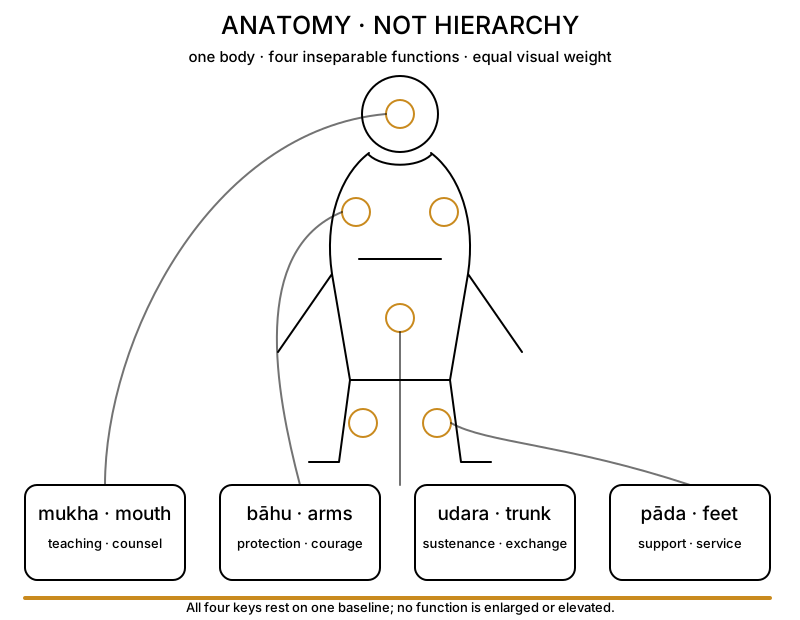
Read as function, the four are a description of any organisation that works — a family, a company, an army, a village, a body. Knowledge sets direction; authority protects and decides; production supplies means; execution carries it out. Remove any one and the remaining three fail within a season.
Brāhmaṇa
Holds knowledge and truth for the whole. Its temptation is arrogance; its discipline is poverty of possessions and richness of learning.
Kṣatriya
Holds power on behalf of others. Its temptation is domination; its discipline is protecting the weakest first.
Vaiśya
Holds and circulates wealth and food. Its temptation is hoarding; its discipline is generosity and honest exchange.
Śūdra
Holds and moves the entire structure. Its temptation is resentment; its dignity is that nothing whatever stands without it.
What is Sanātana Dharma
Sanātana Dharma is not a religion, a founder's creed or a cult — it is the eternal natural law by which every …
Dharma — the word, and why it cannot be translated
Dharma is not religion, not morality and not law, though it touches all three. Its root meaning, its ten chara…
Svadharma — your own duty, and why it outranks a better one
The Gītā's central instruction, its two verses, the reasoning behind them, how to recognise your own svadharma…
The 28 nakṣatras and their four varṇa groups
The twenty-eight nakṣatras fall into four groups of seven, one for each varṇa temperament. The full table, the…
Ṛta — the cosmic order that dharma rests on
Before dharma, the Ṛgveda speaks of ṛta: the impersonal order by which the sun rises, the seasons turn and tru…
Piṇḍa and Brahmāṇḍa — the body and the universe are one pattern
Yat piṇḍe tat brahmāṇḍe — whatever is in this body is in the cosmos. The correspondences of element, breath, s…
Last revised 2026-08-16. Corrections are welcome — see how this site is written.