The tattvas — how existence is layered
तत्त्व
Also written: tattva · 25 tattvas · 36 tattvas · kanchukas · elements hinduism · pancha mahabhuta · तत्त्व
Tattva means 'that-ness' — a principle, a level of reality. The tattva schemes are maps of the descent from pure consciousness to solid matter, and because piṇḍa and brahmāṇḍa share one pattern, the same map reads as cosmology and as anatomy.
Sāṅkhya's twenty-five
| Group | Tattvas |
|---|---|
| Consciousness | Puruṣa |
| Root of nature | Prakṛti |
| Inner instrument | Buddhi (mahat), ahaṅkāra, manas |
| Five jñānendriyas | Ear, skin, eye, tongue, nose |
| Five karmendriyas | Speech, hands, feet, elimination, generation |
| Five tanmātras | Sound, touch, form, taste, smell |
| Five mahābhūtas | Ākāśa, vāyu, agni, jala, pṛthivī |
That table is a list; the Sāṅkhya Kārikā states it as a derivation, in one verse, and the derivation is what makes it a philosophy rather than an inventory.
prakṛter mahāṁs tato'haṅkāras tasmād gaṇaś ca ṣoḍaśakaḥ tasmād api ṣoḍaśakāt pañcabhyaḥ pañca bhūtāni
From prakṛti, mahat; from that, ahaṅkāra; from that, the group of sixteen; and from five of that sixteen, the five elements.
Read the order. Mahat — the great one, cosmic intelligence — comes before ahaṅkāra, the I-maker. Intelligence is prior to the sense of being a separate someone; the separate someone is a product. And the elements come last, from five of the sixteen, meaning the five tanmātras. Solid matter is at the far end of the sequence, derived from subtle qualities, which are derived from an ego-function, which is derived from intelligence. Sāṅkhya is not materialist and it is not idealist: it derives matter from within nature, and leaves puruṣa entirely outside the derivation.
The Taittirīya Upaniṣad gives the same descent, in prose, and extends it two steps further than Sāṅkhya does — down to plants and to the person who eats them.
तस्माद्वा एतस्मादात्मन आकाशः सम्भूतः। आकाशाद्वायुः। वायोरग्निः। अग्नेरापः। अद्भ्यः पृथिवी। पृथिव्या ओषधयः। ओषधीभ्योऽन्नम्। अन्नात्पुरुषः॥
tasmād vā etasmād ātmana ākāśaḥ sambhūtaḥ. ākāśād vāyuḥ. vāyor agniḥ. agner āpaḥ. adbhyaḥ pṛthivī. pṛthivyā oṣadhayaḥ. oṣadhībhyo'nnam. annāt puruṣaḥ
From that Self, space came to be; from space, air; from air, fire; from fire, water; from water, earth; from earth, plants; from plants, food; from food, the person.
The five elements and their signatures
| Element | Tanmātra | Sense | Organ of action | Quality |
|---|---|---|---|---|
| Ākāśa — space | Sound | Ear | Speech | Unobstructing; gives room |
| Vāyu — air | Touch | Skin | Hands | Movement |
| Agni — fire | Form | Eye | Feet | Transformation |
| Jala — water | Taste | Tongue | Generation | Cohesion |
| Pṛthivī — earth | Smell | Nose | Elimination | Solidity |
इन्द्रियेभ्यः परा ह्यर्था अर्थेभ्यश्च परं मनः। मनसस्तु परा बुद्धिर्बुद्धेरात्मा महान्परः॥
indriyebhyaḥ parā hy arthā arthebhyaś ca paraṁ manaḥ manasas tu parā buddhir buddher ātmā mahān paraḥ
Higher than the senses are their objects; higher than the objects, the mind; higher than the mind, the intellect; higher than the intellect, the great Self.
महतः परमव्यक्तमव्यक्तात्पुरुषः परः। पुरुषान्न परं किञ्चित्सा काष्ठा सा परा गतिः॥
mahataḥ param avyaktam avyaktāt puruṣaḥ paraḥ puruṣān na paraṁ kiñcit sā kāṣṭhā sā parā gatiḥ
Higher than the great is the unmanifest; higher than the unmanifest, the Puruṣa. Beyond the Puruṣa there is nothing at all: that is the limit, that is the highest goal.
Puruṣān na paraṁ kiñcit — beyond the Puruṣa, nothing. The Kaṭha closes the ladder there, and so does classical Sāṅkhya. The Śaiva traditions of Kashmir reopen it, and their entire disagreement with Sāṅkhya is contained in that one move.
Kashmir Śaivism's thirty-six
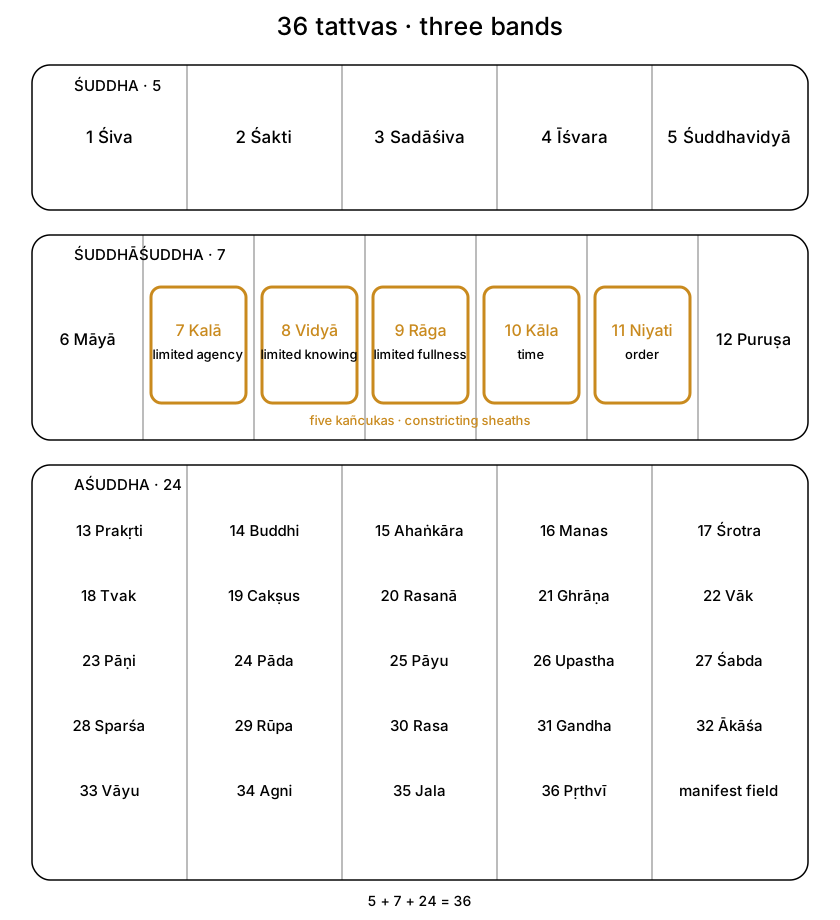
Trika accepts Sāṅkhya's twenty-five and adds eleven above them, because it holds that puruṣa and prakṛti are not the top of the ladder.
| Band | Tattvas | Character |
|---|---|---|
| Śuddha — pure (1–5) | Śiva, Śakti, Sadāśiva, Īśvara, Sadvidyā | Undivided consciousness; 'I am this' with no separation yet |
| Śuddhāśuddha — pure-impure (6–11) | Māyā and the five kañcukas: kalā, vidyā, rāga, kāla, niyati | The limiting sheaths by which the unlimited appears limited |
| Aśuddha — impure (12–36) | Puruṣa, prakṛti and the remaining twenty-three of Sāṅkhya | The world of experience as ordinarily known |
| Kañcuka | Limits | So the infinite appears as |
|---|---|---|
| Kalā | Omnipotence | A being who can do some things |
| Vidyā | Omniscience | A being who knows some things |
| Rāga | Completeness | A being who wants something |
| Kāla | Eternity | A being in time, with a before and after |
| Niyati | Freedom and pervasion | A being in one place, bound by cause |
Two of the five kañcukas — kāla and niyati — are not Śaiva inventions. They appear in the Śvetāśvatara's opening survey of everything that had ever been proposed as the world's cause, where they are listed and then, one by one, set aside.
कालः स्वभावो नियतिर्यदृच्छा भूतानि योनिः पुरुष इति चिन्त्या।
kālaḥ svabhāvo niyatir yadṛcchā bhūtāni yoniḥ puruṣa iti cintyā
Time, inherent nature, necessity, chance, the elements, the womb, the person — these are to be considered.
Kāla and niyati are there, in the oldest list, as candidate first principles: time as the ruler of all, and necessity as the fixed order that leaves no room. The Śaiva move is to demote both — what was proposed as the ultimate cause becomes the sixth and eleventh rung of a ladder, a limitation rather than a sovereign. The same Upaniṣad states what it puts in their place.
मायां तु प्रकृतिं विद्यान्मायिनं तु महेश्वरम्। तस्यावयवभूतैस्तु व्याप्तं सर्वमिदं जगत्॥
māyāṁ tu prakṛtiṁ vidyān māyinaṁ tu maheśvaram tasyāvayava-bhūtais tu vyāptaṁ sarvam idaṁ jagat
Know prakṛti to be māyā, and the wielder of māyā to be the Great Lord. This whole world is pervaded by what are His own parts.
Māyin — the one who wields māyā. The word makes māyā an instrument in someone's hand rather than an independent stuff, and the second line refuses the alternative reading by which the world would be an illusion cast over nothing: the world is pervaded by His own parts. Kashmir Śaivism's whole quarrel with a world-denying Advaita is compressed into that line, and it is a line of śruti.
Time — the yugas, kalpas and cycles
Cyclical time on an enormous scale: the four yugas and their lengths, the manvantaras, a day of Brahmā, and wh…
Karma and rebirth
The three kinds of karma, what free will means inside it, the subtle body that carries it, and why the doctrin…
The lokas — the planes of existence
The fourteen worlds, the three-world formula of daily invocation, and how the lokas are read as states rather …
Pañcāṅga — the reckoning of time
The five limbs of the Indian calendar, the lunisolar year, the two ayanas and six ṛtus, and how a muhūrta is c…
Last revised 2026-08-16. Corrections are welcome — see how this site is written.