Time — the yugas, kalpas and cycles
काल
Also written: yuga · kali yuga · satya treta dvapara kali · kalpa · hindu time cycles · manvantara · युग
Time here is not a line but a wheel, and the wheel is very large. The scale is one of the tradition's most distinctive features: no other ancient cosmology works in units of billions of years.
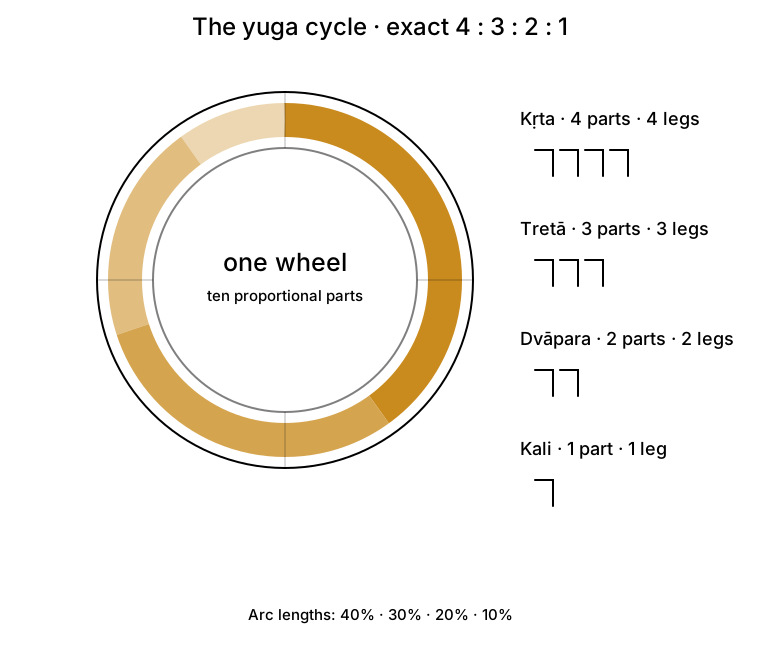
| Yuga | Length | Dharma standing on | Character |
|---|---|---|---|
| Satya / Kṛta | 1,728,000 years | Four legs | Truth undiminished; no need of law, because none departs from it |
| Tretā | 1,296,000 years | Three legs | A quarter lost; sacrifice becomes the principal means |
| Dvāpara | 864,000 years | Two legs | Half lost; the Veda is divided; disease and discord appear |
| Kali | 432,000 years | One leg | Three-quarters lost; the age we are held to be in |
| Unit | Composition | Years |
|---|---|---|
| Mahāyuga | The four yugas together | 4,320,000 |
| Manvantara | 71 mahāyugas, ruled by one Manu | 306,720,000 |
| Kalpa — a day of Brahmā | 14 manvantaras with junctions | 4,320,000,000 |
| A night of Brahmā | Equal, in dissolution | 4,320,000,000 |
| Brahmā's lifespan | 100 years of such days and nights | 311.04 trillion |
Where the figures come from
Manu gives the arithmetic plainly, and gives it in divine years — which is the step that most modern retellings skip, and the reason the numbers seem to appear from nowhere.
catvāry āhuḥ sahasrāṇi varṣāṇāṁ tat kṛtaṁ yugam tasya tāvac chatī sandhyā sandhyāṁśaś ca tathāvidhaḥ
Four thousand years, they say, is the Kṛta yuga; its twilight is as many hundreds, and its twilight-portion the same.
catvāry etāni yugāni gaṇitāni samāsataḥ dvādaśa-sāhasram etad devānāṁ yugam ucyate
These four yugas, reckoned together, come to twelve thousand — and this is called a yuga of the gods.
Twelve thousand divine years, and a divine year is taken as three hundred and sixty human ones: 12,000 × 360 = 4,320,000, the mahāyuga of the table above. Every figure in that table is generated from this one multiplication. Note also that each yuga carries a sandhyā and a sandhyāṁśa — a dawn and a dusk — so that no age begins or ends on a date. The system has no sharp boundaries anywhere in it, which is worth remembering whenever someone announces that an age has just started.
The day of Brahmā
The Gītā states the largest unit in a single verse, and states it as a piece of knowledge that identifies who is speaking.
सहस्रयुगपर्यन्तमहर्यद्ब्रह्मणो विदुः। रात्रिं युगसहस्रान्तां तेऽहोरात्रविदो जनाः॥
sahasra-yuga-paryantam ahar yad brahmaṇo viduḥ rātriṁ yuga-sahasrāntāṁ te'ho-rātra-vido janāḥ
Those who know that a day of Brahmā extends to a thousand yugas, and that his night likewise ends after a thousand yugas — they are the people who know day and night.
The last phrase is the sting: aho-rātra-vidaḥ, 'knowers of day and night'. The implication is that whoever measures time only by sunrise and sunset does not yet know what a day is. And the next verse says what the two halves of that day contain.
अव्यक्ताद्व्यक्तयः सर्वाः प्रभवन्त्यहरागमे। रात्र्यागमे प्रलीयन्ते तत्रैवाव्यक्तसंज्ञके॥
avyaktād vyaktayaḥ sarvāḥ prabhavanty ahar-āgame rātry-āgame pralīyante tatraivāvyakta-saṁjñake
At the coming of day, all manifest things issue from the unmanifest; at the coming of night, they dissolve into that same thing called the unmanifest.
The Kali yuga, honestly
By the traditional reckoning Kali yuga began at Kṛṣṇa's departure, around 3102 BCE, and runs 432,000 years — so roughly five thousand years of it have passed and it has a very long way to go. The Purāṇas describe its character bluntly: wealth becomes the measure of worth, appearance the measure of merit, and law the instrument of the strong. They also state its one compensation, repeatedly and emphatically, and they state it as a strict equation between the ages.
dhyāyan kṛte yajan yajñais tretāyāṁ dvāpare'rcayan yad āpnoti tad āpnoti kalau saṅkīrtya keśavam
What one obtains in Kṛta by meditating, in Tretā by sacrifices, in Dvāpara by temple worship — that one obtains in Kali by singing the name of Keśava.
The grammar does the work: yad āpnoti tad āpnoti — 'what one obtains, that one obtains'. The result is held constant across all four ages and only the method is varied, in descending order of cost. Meditation requires solitude and a lifetime; sacrifice requires wealth, priests and a ritual ground; temple worship requires a temple. Singing requires a voice. The Bhāgavata puts the same point as a paradox and is blunt about the trade.
kaler doṣa-nidhe rājann asti hy eko mahān guṇaḥ kīrtanād eva kṛṣṇasya mukta-saṅgaḥ paraṁ vrajet
In Kali, an ocean of faults, O king, there is yet one great virtue: by the singing of Kṛṣṇa's name alone, one is freed from bondage and reaches the supreme.
Four dissolutions
| Pralaya | Scope |
|---|---|
| Nitya | Constant — the perishing of individual things moment by moment |
| Naimittika | At the end of a day of Brahmā; the three worlds withdrawn, Brahmā sleeps |
| Prākṛtika | At the end of Brahmā's life; the elements resolve back into prakṛti |
| Ātyantika | Final — the liberation of an individual, which ends the cycle for that being |
The tattvas — how existence is layered
Sāṅkhya's twenty-five and Kashmir Śaivism's thirty-six: the levels between pure consciousness and solid earth,…
Karma and rebirth
The three kinds of karma, what free will means inside it, the subtle body that carries it, and why the doctrin…
The lokas — the planes of existence
The fourteen worlds, the three-world formula of daily invocation, and how the lokas are read as states rather …
Pañcāṅga — the reckoning of time
The five limbs of the Indian calendar, the lunisolar year, the two ayanas and six ṛtus, and how a muhūrta is c…
Last revised 2026-08-16. Corrections are welcome — see how this site is written.