The principal Upaniṣads, one by one
मुख्य उपनिषद्
Also written: principal upanishads · dasopanishad · ten upanishads · isha kena katha prashna mundaka mandukya
Thirteen texts, each short enough to be read in an afternoon and deep enough to have sustained two thousand years of commentary.
Īśa Upaniṣad
Eighteen verses, embedded in the Yajurveda Saṁhitā itself. Its achievement is to refuse the choice between world and renunciation: enjoy by renouncing, and covet no one's wealth. It condemns the pursuit of ritual without knowledge and of knowledge without action in the same breath, and ends with the prayer to the golden disc that covers the face of truth.
ईशावास्यमिदं सर्वं यत्किञ्च जगत्यां जगत्। तेन त्यक्तेन भुञ्जीथा मा गृधः कस्यस्विद्धनम्॥
īśāvāsyam idaṁ sarvaṁ yat kiñca jagatyāṁ jagat tena tyaktena bhuñjīthā mā gṛdhaḥ kasya svid dhanam
All this is pervaded by the Lord — whatever moves in this moving world. Enjoy through renunciation; do not covet, for whose is wealth?
Kena Upaniṣad
It begins with four questions: by whom willed does the mind go forth, by whom is the breath directed, by whom is speech uttered, what god directs the eye and ear? The answer is the ear of the ear, the mind of the mind — that which cannot be an object of knowing because it is the knower. Its most famous line is a deliberate reversal.
यस्यामतं तस्य मतं मतं यस्य न वेद सः। अविज्ञातं विजानतां विज्ञातमविजानताम्॥
yasyāmataṁ tasya mataṁ mataṁ yasya na veda saḥ avijñātaṁ vijānatāṁ vijñātam avijānatām
He who thinks he does not know, knows; he who thinks he knows, does not. It is unknown to those who know, and known to those who do not know.
This is not a riddle for its own sake; it follows strictly from the position argued in the first chapter. If Brahman is the knower, it can never be an object of knowledge, and to claim 'I know Brahman' is to have made it into an object and therefore to have missed it. The one who says he does not know has at least not committed that error. The Upaniṣad is describing a limit that is structural rather than a difficulty that could be overcome by more study — which is why the very next verse says Brahman is known in every act of awakening, pratibodha-viditam, rather than at the end of an investigation.
Kaṭha Upaniṣad
The boy Naciketas is given to Death by his father in anger, waits three nights at Yama's door, and is offered three boons. With the third he asks what remains after a person dies. Yama offers him sons, cattle, land, long life and every pleasure to avoid the question; Naciketas refuses them all. What follows is the clearest teaching on the Self in the corpus, and it includes the image the tradition has used ever since.
आत्मानं रथिनं विद्धि शरीरं रथमेव तु। बुद्धिं तु सारथिं विद्धि मनः प्रग्रहमेव च॥
ātmānaṁ rathinaṁ viddhi śarīraṁ ratham eva tu buddhiṁ tu sārathiṁ viddhi manaḥ pragraham eva ca
Know the Self as the rider in the chariot, and the body as the chariot; know the intellect as the charioteer, and the mind as the reins.
इन्द्रियाणि हयानाहुर्विषयांस्तेषु गोचरान्। आत्मेन्द्रियमनोयुक्तं भोक्तेत्याहुर्मनीषिणः॥
indriyāṇi hayān āhur viṣayāṁs teṣu gocarān ātmendriya-mano-yuktaṁ bhoktety āhur manīṣiṇaḥ
The senses they call the horses, and the objects the roads they range over. The Self joined to the senses and the mind, the wise call the experiencer.
Every element of the image does work. The rider does not pull the reins — the intellect does; so discrimination, not the Self, is what steers. The mind is the reins and therefore the transmission, not the driver: a fact that decides the whole later argument about whether mental control is the goal or the instrument. The horses are not the problem — a chariot without horses goes nowhere — but horses without reins take the rider wherever they smell food. And the passenger is called bhoktṛ, the experiencer, only when joined to the senses and mind; unjoined, it is not an experiencer at all. That last qualification is where the Sāṅkhya and Vedāntic accounts of bondage begin.
नायमात्मा प्रवचनेन लभ्यो न मेधया न बहुना श्रुतेन।
nāyam ātmā pravacanena labhyo na medhayā na bahunā śrutena
This Self is not attained by discourse, nor by intelligence, nor by much hearing.
Three qualifications are ruled out in a single line, and they are precisely the three a scholar would rely on: exposition, cleverness, and extensive reading. The verse continues that the Self is attained by the one whom it chooses — a statement that sits uneasily with the rest of the Upaniṣad's emphasis on effort, and the schools divide on it. Advaita reads 'chooses' as describing the one who wants nothing else; the theistic schools read it as grace. Both readings are old, and the text does not settle between them.
Praśna Upaniṣad
Six students bring six questions to the sage Pippalāda: where do creatures come from; how many powers sustain the body; how does prāṇa enter and divide; what sleeps and what wakes; what is gained by meditating on Om; and who is the person with sixteen parts. The treatment of prāṇa and its five divisions here is foundational for all later yoga.
ते ह समित्पाणयो भगवन्तं पिप्पलादमुपसन्नाः।
te ha samit-pāṇayo bhagavantaṁ pippalādam upasannāḥ
They approached the venerable Pippalāda with fuel in their hands.
Samit-pāṇi — 'with firewood in hand' — is the formal sign of a student presenting himself, and it recurs at the opening of several Upaniṣads. The fuel is for the teacher's fire, and it is the outward form of a condition the texts take seriously: the enquirer arrives having already accepted the discipline of the household he is entering. Pippalāda's response is equally characteristic — he tells them to live with him another year in tapas, celibacy and faith, and then to ask. The delay is part of the teaching, and it is why these texts have no genre equivalent in a literature of public argument.
Muṇḍaka Upaniṣad
It opens by dividing knowledge in two: aparā vidyā, the lower — including all four Vedas and the six limbs — and parā vidyā, the higher, by which the imperishable is known. This is the tradition's own statement that textual mastery is not the goal. It gives the image of two birds on one tree, one eating the fruit and one watching without eating, and the line now on India's state emblem.
सत्यमेव जयते नानृतं सत्येन पन्था विततो देवयानः।
satyam eva jayate nānṛtaṁ satyena panthā vitato devayānaḥ
Truth alone triumphs, not falsehood; by truth is laid out the path travelled by the gods.
The national motto stops at the fourth word. The rest of the verse is what gives it content: truth is not merely victorious, it is the road — the devayāna, the path by which the seers go to where the treasure of truth is. Read whole, the sentence is not a prediction that honesty will win in the end but a claim that truthfulness is the means of transit itself. That is why the Upaniṣad places it immediately after saying the Self is attained by truth, by austerity, by right knowledge and by continence — and not by other means.
Māṇḍūkya Upaniṣad
Twelve verses, the shortest of the principal Upaniṣads, and the one the Muktikā says suffices alone for liberation. It analyses consciousness into four: waking (vaiśvānara), dream (taijasa), deep sleep (prājña), and the fourth (turīya) which is not a state but their ground — and maps them onto A, U, M and the silence after Om. Gauḍapāda's Kārikā on it is the earliest systematic Advaita text.
नान्तःप्रज्ञं न बहिष्प्रज्ञं नोभयतःप्रज्ञं न प्रज्ञानघनं न प्रज्ञं नाप्रज्ञम्। अदृष्टमव्यवहार्यमग्राह्यमलक्षणमचिन्त्यमव्यपदेश्यमेकात्मप्रत्ययसारं प्रपञ्चोपशमं शान्तं शिवमद्वैतं चतुर्थं मन्यन्ते स आत्मा स विज्ञेयः॥
nāntaḥ-prajñaṁ na bahiṣ-prajñaṁ nobhayataḥ-prajñaṁ na prajñāna-ghanaṁ na prajñaṁ nāprajñam | adṛṣṭam avyavahāryam agrāhyam alakṣaṇam acintyam avyapadeśyam ekātma-pratyaya-sāraṁ prapañcopaśamaṁ śāntaṁ śivam advaitaṁ caturthaṁ manyante sa ātmā sa vijñeyaḥ
Not inwardly aware, not outwardly aware, not aware both ways, not a mass of awareness, not aware, not unaware; unseen, beyond dealing, ungraspable, without mark, unthinkable, unnameable, whose essence is the certainty of the one Self, in which all manifestation has come to rest, at peace, auspicious, without a second — this they consider the fourth. That is the Self; that is to be known.
Count the negations: six that rule out every possible relation to awareness, then six more that rule out perception, transaction, grasp, characteristic, thought and naming. Only after twelve refusals does a single positive phrase appear — ekātma-pratyaya-sāra, whose essence is the certainty of the one Self — followed by four adjectives and the instruction that this is to be known. The method is exactly the neti neti of the Bṛhadāraṇyaka executed in one sentence, and its logic is strict: anything that could be described would thereby be an object, and the fourth is not an object. Gauḍapāda built the whole of early Advaita on this verse.
Taittirīya Upaniṣad
Three chapters. The first is the śikṣā-vallī, ending with the graduation address a teacher gives a departing student — the oldest convocation speech in the world, and still recited at Indian university ceremonies.
सत्यं वद। धर्मं चर। स्वाध्यायान्मा प्रमदः। मातृदेवो भव। पितृदेवो भव। आचार्यदेवो भव। अतिथिदेवो भव॥
satyaṁ vada | dharmaṁ cara | svādhyāyān mā pramadaḥ mātṛ-devo bhava | pitṛ-devo bhava | ācārya-devo bhava | atithi-devo bhava
Speak the truth. Practise dharma. Do not neglect your own study. Be one to whom the mother is a god, the father is a god, the teacher is a god, the guest is a god.
The grammar of the four bhava clauses is often mistranslated. Mātṛ-devo bhava does not mean 'your mother is a god'; it is a bahuvrīhi — 'be one whose god is his mother'. The instruction is about the student's own attitude, not about the metaphysical status of the four people named. And the fourth of them is a stranger: atithi means literally one who comes without a fixed date, unannounced. A convocation address that ends by placing an unexpected visitor on the same footing as one's parents and teacher is prescribing an ethic of hospitality as a religious obligation, which is how the tradition has treated it since.
The address then does something modern convocation speeches do not: it hands the responsibility back.
यान्यनवद्यानि कर्माणि तानि सेवितव्यानि। नो इतराणि। यान्यस्माकं सुचरितानि तानि त्वयोपास्यानि। नो इतराणि॥
yāny anavadyāni karmāṇi tāni sevitavyāni | no itarāṇi yāny asmākaṁ sucaritāni tāni tvayopāsyāni | no itarāṇi
Those actions of ours that are blameless are to be followed, not the others. Those practices of ours that are good, you should adopt — not the others.
No itarāṇi — 'not the others'. The teacher tells the departing student to imitate his teachers selectively, and states plainly that some of their conduct is not to be imitated. Then, on the question of what to do in a doubtful case, he prescribes observing how the thoughtful, unprejudiced and kindly people of the place behave — sadācāra, arrived at by the student's own judgment. The oldest graduation speech in the world ends by refusing to make itself the final authority.
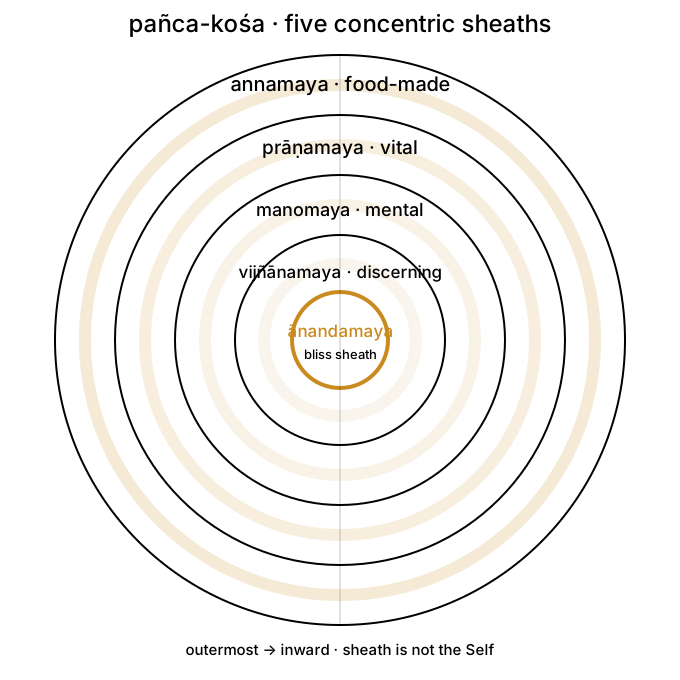
The second chapter gives the pañca-kośa — the five sheaths of food, breath, mind, understanding and bliss — and opens with the definition Vedānta has argued over ever since.
सत्यं ज्ञानमनन्तं ब्रह्म।
satyaṁ jñānam anantaṁ brahma
Brahman is the real, knowledge, the infinite.
Three words, and the schools divide on how they function. Śaṅkara argues that they are not attributes at all — an infinite cannot have attributes, since an attribute distinguishes and to distinguish is to limit — but definitions by exclusion, each ruling out what Brahman is not: not unreal, not inert, not bounded. Rāmānuja reads them as genuine qualities of a being who has them, which is precisely the point at which Viśiṣṭādvaita separates from Advaita. Both readings begin from these three words. The third chapter gives Bhṛgu's enquiry, in which he returns five times to his father with a deeper answer to 'what is Brahman?' — food, then breath, then mind, then understanding, then bliss — the same five sheaths, arrived at by a son's repeated failure to be satisfied.
Aitareya Upaniṣad
Creation proceeds from the Self alone; the cosmic person is formed, the deities enter the body through its openings, and the Self enters last through the crown.
आत्मा वा इदमेक एवाग्र आसीत्। नान्यत्किञ्चन मिषत्।
ātmā vā idam eka evāgra āsīt | nānyat kiñcana miṣat
In the beginning, this was the Self alone — nothing else whatsoever blinked.
Miṣat — 'blinking' — is a strange and precise word for 'existing'. It marks what is alive and aware rather than what merely occupies space, and the sentence therefore denies not that anything was there but that anything else was awake. That framing decides the direction of the whole text and delivers its mahāvākya: prajñānaṁ brahma, consciousness is Brahman (3.3). The Aitareya's cosmology is a cosmology of awareness, and it says so in its first line.
Chāndogya Upaniṣad
Eight chapters of the Sāmaveda tradition. It contains the teaching of Uddālaka Āruṇi to his son Śvetaketu, who returns from twelve years of study proud of his learning; his father asks whether he has learnt that by which the unheard becomes heard. The chapter ends nine times with tat tvam asi — that thou art. It also contains the dialogue of Nārada and Sanatkumāra, and the honey doctrine.
सर्वं खल्विदं ब्रह्म तज्जलानिति शान्त उपासीत। अथ खलु क्रतुमयः पुरुषो यथाक्रतुरस्मिँल्लोके पुरुषो भवति तथेतः प्रेत्य भवति।
sarvaṁ khalv idaṁ brahma taj-jalān iti śānta upāsīta | atha khalu kratu-mayaḥ puruṣo yathā-kratur asmiṁl loke puruṣo bhavati tathetaḥ pretya bhavati
All this is Brahman. Let one meditate on it, tranquil, as that from which all arises, into which all dissolves, and by which all breathes. Now, a person is made of resolve; as is his resolve in this world, so he becomes on departing hence.
Two claims in one sentence, and the second is the practical one. Kratu-maya — 'made of resolve, constituted by intention'. The Upaniṣad is not saying that a person's intentions determine his reward but that they constitute what he is, and therefore what he becomes. Tajjalān is a compressed triple: tat-ja (born from That), tat-la (dissolving into That), tat-an (breathing by That). One is asked to meditate on the world's origin, end and sustenance as a single thing, and the practical consequence drawn is about the quality of one's own intentions. That is the shortest route in the corpus from metaphysics to conduct.
Bṛhadāraṇyaka Upaniṣad
The largest and, with the Chāndogya, the oldest. It contains Yājñavalkya's dialogues — with the assembled scholars of Janaka's court, with Gārgī who questions him until he warns her that her head will fall off, and above all with his wife Maitreyī. Its method is neti neti — not this, not this — the systematic refusal of every description.
Yājñavalkya, about to leave for the forest, offers to divide his property between his two wives. Maitreyī asks whether all the wealth in the world would make her immortal. He says no — there is no hope of immortality through wealth. She replies: then what should I do with what will not make me immortal? Tell me, sir, what you know. His answer begins with the sentence that reframes every attachment she has.
न वा अरे पत्युः कामाय पतिः प्रियो भवति आत्मनस्तु कामाय पतिः प्रियो भवति।
na vā are patyuḥ kāmāya patiḥ priyo bhavati ātmanas tu kāmāya patiḥ priyo bhavati
Truly, it is not for the husband's sake that the husband is dear, but for the sake of the Self that the husband is dear.
He repeats the formula for the wife, the sons, wealth, the priesthood, the worlds, the gods, all beings — nine times, with the same structure. It is easily misread as a doctrine of enlightened selfishness. The argument is the reverse: if what is loved in every beloved thing is the Self, then the Self is what is common to all of them, and the correct object of enquiry is not any of the things but the one thing found in all. The passage ends with the instruction that has organised Vedāntic practice ever since — the Self is to be seen, heard about, reflected upon and deeply meditated upon: śravaṇa, manana, nididhyāsana.
आत्मा वा अरे द्रष्टव्यः श्रोतव्यो मन्तव्यो निदिध्यासितव्यः।
ātmā vā are draṣṭavyaḥ śrotavyo mantavyo nididhyāsitavyaḥ
The Self, my dear, is to be seen — to be heard of, to be reflected upon, to be deeply contemplated.
The order is a syllabus and it is not negotiable. Śravaṇa is hearing the teaching from a competent source; manana is subjecting it to reasoning until doubt is removed; nididhyāsana is sustained contemplation until it is no longer a conclusion held but a fact seen. Reasoning stands in the middle — after hearing and before contemplation — which is the tradition's formal answer to whether faith or enquiry comes first: neither alone, and in this sequence. Its prayer is the one recited across the world: lead me from the unreal to the real, from darkness to light, from death to immortality.
असतो मा सद्गमय। तमसो मा ज्योतिर्गमय। मृत्योर्मामृतं गमय॥
asato mā sad gamaya | tamaso mā jyotir gamaya | mṛtyor mā amṛtaṁ gamaya
From the unreal lead me to the real; from darkness lead me to light; from death lead me to immortality.
Śvetāśvatara, Kauṣītaki and Maitrāyaṇīya
Śvetāśvatara is the most theistic of the classical Upaniṣads — it names Rudra as the one Lord, uses the vocabulary of Sāṅkhya and Yoga, and is a principal source for Śaiva Vedānta. Its central verse states a position that is neither plain monism nor plain theism.
एको देवः सर्वभूतेषु गूढः सर्वव्यापी सर्वभूतान्तरात्मा। कर्माध्यक्षः सर्वभूताधिवासः साक्षी चेता केवलो निर्गुणश्च॥
eko devaḥ sarva-bhūteṣu gūḍhaḥ sarva-vyāpī sarva-bhūtāntarātmā karmādhyakṣaḥ sarva-bhūtādhivāsaḥ sākṣī cetā kevalo nirguṇaś ca
One God, hidden in all beings, all-pervading, the inner Self of all beings; overseer of works, dwelling in all beings, the witness, the knower, alone and without qualities.
The verse holds together terms that later schools split apart. Eko devaḥ is theistic; nirguṇa is Advaitic; sākṣī, the witness, belongs to the analysis of consciousness; karmādhyakṣa, overseer of works, is a moral governor. That a single Upaniṣadic verse contains all four is a large part of the reason the Vedānta schools could each claim the corpus honestly — the source material genuinely does say all of these things, and the schools differ in which they take as primary and which they explain as secondary.
Kauṣītaki treats prāṇa and the after-death path in detail. Maitrāyaṇīya gives an early and vivid account of the mind as the cause of bondage and freedom alike — the source of the maxim, repeated throughout the later yoga literature, that mind alone is the cause of a person's bondage and liberation.
The sources of knowledge in Sanātana Dharma
The complete library: Nigama and Āgama, śruti and smṛti, the four Vedas with their four layers, the six Vedāṅg…
Śruti — that which was heard
What apauruṣeya means, how the Veda was preserved syllable-perfect for millennia without writing, and why śrut…
Smṛti — that which was remembered
The vast human-authored body: Vedāṅga, Itihāsa, Purāṇa, Dharma Śāstra, Sūtra, Darśana, Āgama and Kāvya — deriv…
Nigama and Āgama — the two revealed streams
The Vedic and the Tantric revelations: their different forms, their different eligibility rules, why every tem…
The four Vedas
Ṛgveda, Yajurveda, Sāmaveda and Atharvaveda — what each contains, the priest each belongs to, its śākhās, and …
Ṛgveda
The oldest surviving text of the tradition: 1,028 hymns in ten maṇḍalas, its structure, its great hymns, and w…
Last revised 2026-08-16. Corrections are welcome — see how this site is written.