The Daśāvatāra — the ten descents
दशावतार
Also written: dashavatara · ten avatars of vishnu · avatar · matsya kurma varaha · kalki · दशावतार
Avatāra means 'a descent' — not an incarnation in the sense of a soul taking birth, but the deliberate coming-down of the divine into form for a stated purpose.
The word is defined by the verse that precedes the promise, and the definition rules out the obvious misreading — that a descent is a birth like any other.
अजोऽपि सन्नव्ययात्मा भूतानामीश्वरोऽपि सन्। प्रकृतिं स्वामधिष्ठाय सम्भवाम्यात्ममायया॥
ajo'pi sann avyayātmā bhūtānām īśvaro'pi san prakṛtiṁ svām adhiṣṭhāya sambhavāmy ātma-māyayā
Though unborn, though My nature is imperishable, though I am the Lord of beings — governing My own prakṛti, I come into being by My own māyā.
Three concessive clauses, each beginning 'though', and then the verb. The point of the construction is that nothing in the descent is a change of state: the unborn does not become born, the imperishable does not become perishable, the Lord does not become subject. Adhiṣṭhāya — 'standing over, presiding on' — keeps the relation asymmetrical. This is what distinguishes an avatāra from a jīva taking a body under the compulsion of karma, and it is why the tradition never speaks of an avatāra as reaping the fruit of past action.
यदा यदा हि धर्मस्य ग्लानिर्भवति भारत। अभ्युत्थानमधर्मस्य तदात्मानं सृजाम्यहम्॥
yadā yadā hi dharmasya glānir bhavati bhārata abhyutthānam adharmasya tadātmānaṁ sṛjāmy aham
Whenever there is a decline of dharma, Bhārata, and a rising up of adharma, then I send forth Myself.
Yadā yadā — 'whenever, whenever'. The repetition makes the promise recurrent and conditional rather than a single historical event, and the following verse states the three purposes, in an order that is usually misquoted.
परित्राणाय साधूनां विनाशाय च दुष्कृताम्। धर्मसंस्थापनार्थाय सम्भवामि युगे युगे॥
paritrāṇāya sādhūnāṁ vināśāya ca duṣkṛtām dharma-saṁsthāpanārthāya sambhavāmi yuge yuge
For the protection of the good, for the destruction of wrongdoers, and for the firm establishment of dharma, I come into being age after age.
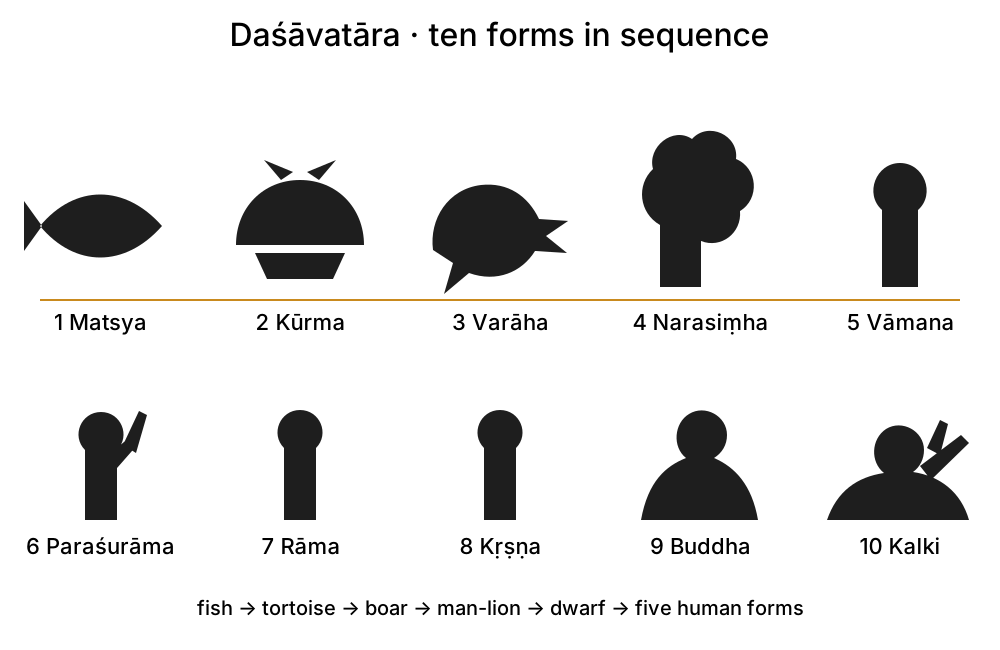
| # | Avatāra | Form | Yuga | Purpose |
|---|---|---|---|---|
| 1 | Matsya | Fish | Satya | Saves the Vedas and the seed of life from the deluge |
| 2 | Kūrma | Tortoise | Satya | Bears Mandara on his back at the churning of the ocean |
| 3 | Varāha | Boar | Satya | Lifts the earth from the waters |
| 4 | Narasiṁha | Man-lion | Satya | Neither man nor beast, at neither day nor night — the boon that could not be broken, broken |
| 5 | Vāmana | Dwarf brahmin | Tretā | Three steps that measure the worlds; the humbling of Bali |
| 6 | Paraśurāma | Warrior brahmin | Tretā | The correction of a kṣatriya order that had become predatory |
| 7 | Rāma | King | Tretā | Dharma embodied; the ideal of conduct under every pressure |
| 8 | Kṛṣṇa | Cowherd, statesman, teacher | Dvāpara | The Gītā; the turning of the Mahābhārata |
| 9 | Buddha | The awakened | Kali | Compassion and the ending of animal sacrifice — as the Purāṇas themselves record |
| 10 | Kalki | Rider on a white horse | Kali (future) | The close of the age and the turning of the wheel |
Ten is a list, not a count
The Bhāgavata, which supplies most of the material for the ten, states in the same chapter that the number is not a number.
avatārā hy asaṅkhyeyā hare sattva-nidher dvijāḥ yathāvidāsinaḥ kulyāḥ sarasaḥ syuḥ sahasraśaḥ
The descents of Hari, the reservoir of goodness, are innumerable, O twice-born — as thousands of streamlets flow from an inexhaustible lake.
And the Gītā, having promised the descents, immediately makes the practical point about what a devotee is supposed to do with them.
जन्म कर्म च मे दिव्यमेवं यो वेत्ति तत्त्वतः। त्यक्त्वा देहं पुनर्जन्म नैति मामेति सोऽर्जुन॥
janma karma ca me divyam evaṁ yo vetti tattvataḥ tyaktvā dehaṁ punar-janma naiti mām eti so'rjuna
One who thus knows, in truth, My divine birth and action — leaving the body, he does not come to rebirth; he comes to Me, Arjuna.
Tattvataḥ — 'as it is, in its principle'. What liberates is not having heard the stories but having understood what they are stories of; the verse asks for the knowledge that 4.6 supplied, namely that the birth was not a birth. The daśāvatāra is thereby placed in the tradition's ordinary category: an object of contemplation whose value lies in what it is understood to mean, not a chronicle whose value lies in having happened.
Last revised 2026-08-16. Corrections are welcome — see how this site is written.