The four layers — Saṁhitā, Brāhmaṇa, Āraṇyaka, Upaniṣad
वेद विभाग
Also written: samhita brahmana aranyaka upanishad · divisions of veda · parts of the vedas
The Veda is not a book but a graded curriculum. Each of the four Vedas carries four layers, and they are arranged in the order a life is meant to traverse them — act first, understand the act, interiorise it, and finally ask what the actor is.
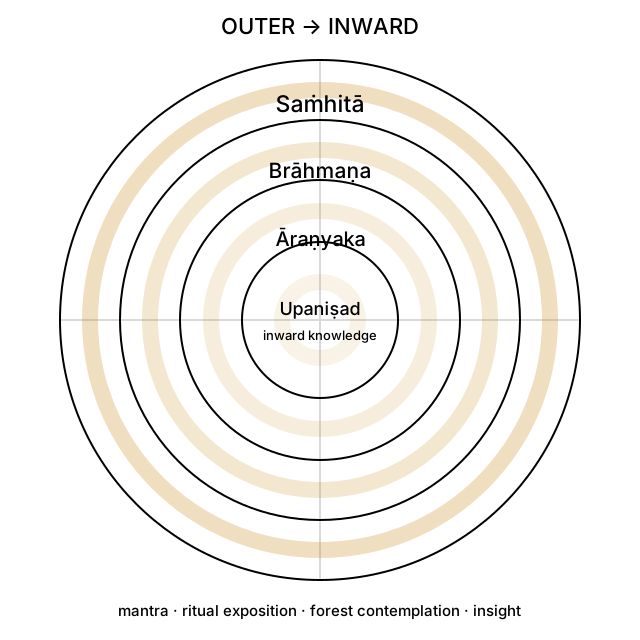
- Saṁhitāसंहिता — the collection
- The mantras themselves: verse, formula and melody. This is the Veda in the strictest sense; the rest explains it.
- Brāhmaṇaब्राह्मण — the explanation
- Prose treatises on the performance of the sacrifice: which mantra, at which moment, with what substance, and what each act means. The Śatapatha Brāhmaṇa is the greatest of them.
- Āraṇyakaआरण्यक — of the forest
- For the one who has withdrawn from the village. The rite is no longer performed outwardly but contemplated: the fire becomes the breath, the offering becomes attention. The bridge between action and knowledge.
- Upaniṣadउपनिषद् — sitting near
- Vedānta, the end of the Veda. Not procedure at all, but enquiry: what is Brahman, what is the Self, what is the relation between them.
| Saṁhitā | Brāhmaṇa | Āraṇyaka | Upaniṣad | |
|---|---|---|---|---|
| Mode | Invocation | Procedure | Contemplation | Enquiry |
| Fire is | Agni the deity | The physical altar | The breath within | A symbol to be seen through |
| Question asked | Whom do I invoke? | How is it done? | What does it mean? | Who am I? |
| Kāṇḍa | Karma | Karma | Transition | Jñāna |
| Āśrama it suits | Student | Householder | Forest-dweller | Renunciate |
The relocation, watched happening
The claim that the layers move from the outward rite to its inward meaning is not an interpretation imposed later. It can be watched in the opening sentence of the largest Upaniṣad, which begins by taking the most elaborate and expensive rite in the entire Vedic system — the aśvamedha — and describing it as the cosmos.
उषा वा अश्वस्य मेध्यस्य शिरः। सूर्यश्चक्षुर्वातः प्राणो व्यात्तमग्निर्वैश्वानरः संवत्सर आत्माश्वस्य मेध्यस्य।
uṣā vā aśvasya medhyasya śiraḥ | sūryaś cakṣur vātaḥ prāṇo vyāttam agnir vaiśvānaraḥ saṁvatsara ātmāśvasya medhyasya
The dawn is the head of the sacrificial horse; the sun its eye, the wind its breath, the universal fire its open mouth, and the year is the body of the sacrificial horse.
Nothing is denied and nothing is abolished. The rite is not called false, superstitious or superseded; it is redescribed at a scale at which no animal is required, because the horse turns out to be the year. That is the Āraṇyaka method in its purest form, and it is why this text is called the Bṛhad-āraṇyaka, the great forest book. The Chāndogya performs the same operation on a human life.
पुरुषो वाव यज्ञस्तस्य यानि चतुर्विंशतिवर्षाणि तत्प्रातःसवनम्।
puruṣo vāva yajñas tasya yāni catur-viṁśati-varṣāṇi tat prātaḥ-savanam
Man himself is the sacrifice. His first twenty-four years are the morning pressing.
A soma sacrifice has three pressings, morning, midday and evening; the Upaniṣad maps them onto the three stages of a hundred-year life, twenty-four years, forty-four and forty-eight. The consequence is precise rather than poetic: a person who lives the whole of a life attentively has performed the rite whether or not he ever kindled a fire. This is the doctrinal opening through which everything later in the tradition — the sacrifice of knowledge, of breath, of action, and the Gītā's whole treatment of karma as offering — comes through.
The disagreement inside the Veda, kept in the Veda
The layers are not always polite to one another, and the tradition did not edit the friction out. The Muṇḍaka, an Upaniṣad of the Atharvaveda, says something about the sacrificial system that no external critic said more sharply.
प्लवा ह्येते अदृढा यज्ञरूपा अष्टादशोक्तमवरं येषु कर्म। एतच्छ्रेयो येऽभिनन्दन्ति मूढा जरामृत्युं ते पुनरेवापि यन्ति॥
plavā hy ete adṛḍhā yajña-rūpā aṣṭādaśoktam avaraṁ yeṣu karma etac chreyo ye'bhinandanti mūḍhā jarā-mṛtyuṁ te punar evāpi yanti
These sacrificial forms are unsteady boats, in which the inferior work is declared in eighteen parts. The fools who welcome this as the highest good go again and again to old age and death.
Plavā adṛḍhāḥ — 'leaky boats'. That verse sits inside śruti, aimed at the practice prescribed by śruti. And the tradition's answer is not to suppress it but to place beside it the Īśa Upaniṣad's ruling, which refuses to let either side win outright.
विद्यां चाविद्यां च यस्तद्वेदोभयं सह। अविद्यया मृत्युं तीर्त्वा विद्ययामृतमश्नुते॥
vidyāṁ cāvidyāṁ ca yas tad vedobhayaṁ saha avidyayā mṛtyuṁ tīrtvā vidyayāmṛtam aśnute
He who knows both knowledge and ignorance together crosses death by ignorance and attains immortality by knowledge.
Ubhayaṁ saha — 'both together' — is the ruling. Avidyā here is not error; in Śaṅkara's reading of this verse it is the sphere of ritual and works, and vidyā is knowledge of the Self. The verse says the works carry you across death and knowledge gives immortality, and that the one who takes only one of the two gets neither result. The Veda thus contains both the sharpest attack on the sacrifice and the ruling that the sacrifice may not be discarded — and it keeps both, which is exactly what a tradition does when it prefers accuracy to tidiness.
The sources of knowledge in Sanātana Dharma
The complete library: Nigama and Āgama, śruti and smṛti, the four Vedas with their four layers, the six Vedāṅg…
Śruti — that which was heard
What apauruṣeya means, how the Veda was preserved syllable-perfect for millennia without writing, and why śrut…
Smṛti — that which was remembered
The vast human-authored body: Vedāṅga, Itihāsa, Purāṇa, Dharma Śāstra, Sūtra, Darśana, Āgama and Kāvya — deriv…
Nigama and Āgama — the two revealed streams
The Vedic and the Tantric revelations: their different forms, their different eligibility rules, why every tem…
The four Vedas
Ṛgveda, Yajurveda, Sāmaveda and Atharvaveda — what each contains, the priest each belongs to, its śākhās, and …
Ṛgveda
The oldest surviving text of the tradition: 1,028 hymns in ten maṇḍalas, its structure, its great hymns, and w…
Last revised 2026-08-16. Corrections are welcome — see how this site is written.