Svara Yoga — the science of the breath
स्वर योग
Also written: swara yoga · svara yoga · shiva swarodaya · nadi ida pingala sushumna · breath science · स्वरयोग
Svara Yoga takes the breath not as something to be controlled but as something to be read. Which nostril is flowing, which element is dominant within that flow, and what the pause between breaths contains — these are its instruments, and its principal text is the Śiva Svarodaya, spoken by Śiva to Pārvatī.
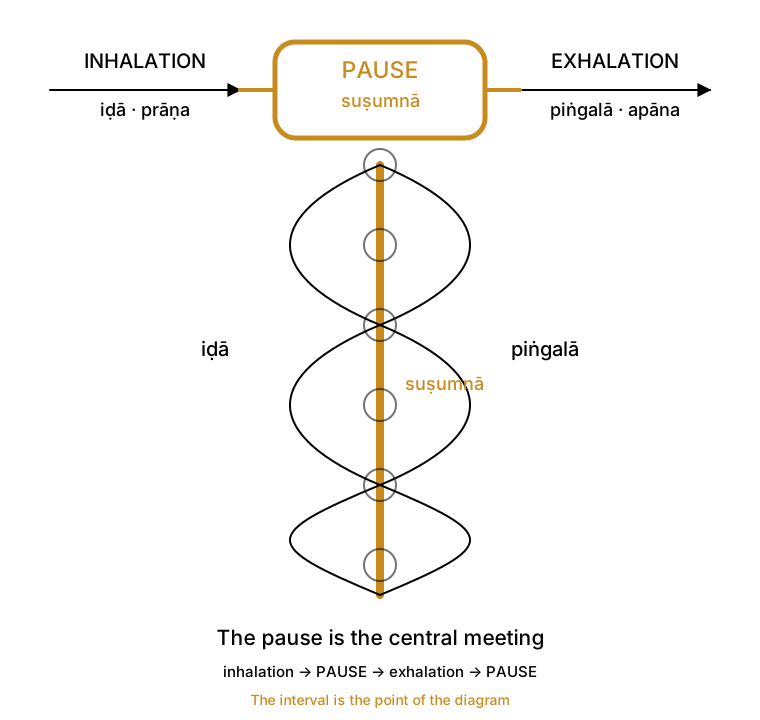
The three nāḍīs
| Nāḍī | Side | Principle | Quality |
|---|---|---|---|
| Iḍā | Left | Candra — the moon | Cooling, receptive, nourishing; governs the mind and the fluids |
| Piṅgalā | Right | Sūrya — the sun | Heating, active, consuming; governs digestion and outward action |
| Suṣumnā | Centre | Agni / the void | Neither; the state in which the elements fall silent |
The Śiva Svarodaya makes a claim for this knowledge that would be absurd if the breath were only respiration — and the claim tells you what the text thinks it is describing.
svara-jñānāt paraṁ guhyaṁ svara-jñānāt paraṁ dhanam svara-jñānāt paraṁ jñānaṁ na vā dṛṣṭaṁ ca śrutam
There is no secret higher than the knowledge of the svara, no wealth higher than the knowledge of the svara, no knowledge higher than the knowledge of the svara — none has been seen or heard of.
Guhya, dhana, jñāna — secret, wealth, knowledge. The three words cover concealment, value and cognition, and the text puts the breath at the top of all three. It can only mean this if the breath is being read as an index of something larger: the same rhythm that turns in the body is held to be turning in the day, the month and the world, so that a person who can read the one has a reading of the other. This is the microcosm-macrocosm principle applied to a single measurable thing.
Prāṇa and apāna — the two motions
The Upaniṣads distribute prāṇa into five functions before the yoga texts ever describe a technique. The Praśna Upaniṣad is the clearest: it locates each function in the body, and the locations are not arbitrary.
पायूपस्थेऽपानं चक्षुःश्रोत्रे मुखनासिकाभ्यां प्राणः स्वयं प्रातिष्ठते मध्ये तु समानः।
pāyūpasthe'pānaṁ cakṣuḥ-śrotre mukha-nāsikābhyāṁ prāṇaḥ svayaṁ prātiṣṭhate madhye tu samānaḥ
Apāna is in the organs of elimination and generation; prāṇa itself is established in the eye and ear, by way of the mouth and nostrils; and in the middle is samāna.
Apāna is placed at what goes down and out. Prāṇa is placed at what comes in — the nostrils and the receiving senses. This is the whole of the doctrine in anatomical form: the inward, receiving, cooling motion is prāṇa, and it is iḍā; the outward, expelling, consuming motion is apāna, and it is piṅgalā. Samāna is placed 'in the middle' — madhye — which is the same word the svara texts use for the pause. The Upaniṣad then adds the network the nāḍīs belong to.
हृदि ह्येष आत्मा। अत्रैतदेकशतं नाडीनां तासां शतं शतमेकैकस्यां द्वासप्ततिर्द्वासप्ततिः प्रतिशाखानाडीसहस्राणि भवन्ति। आसु व्यानश्चरति॥
hṛdi hy eṣa ātmā. atraitad eka-śataṁ nāḍīnāṁ tāsāṁ śataṁ śatam ekaikasyāṁ dvā-saptatir dvā-saptatiḥ pratiśākhā-nāḍī-sahasrāṇi bhavanti. āsu vyānaś carati
Here in the heart is the Self. Here are the hundred and one nāḍīs; each of them has a hundred, and each of those has seventy-two thousand branching nāḍīs. In these vyāna moves.
Suṣumnā — the one channel that goes up
The Kaṭha Upaniṣad singles out one nāḍī from the hundred and one, and the distinction it draws is not of size or position but of direction and destination.
शतं चैका च हृदयस्य नाड्यस्तासां मूर्धानमभिनिःसृतैका। तयोर्ध्वमायन्नमृतत्वमेति विष्वङ्ङन्या उत्क्रमणे भवन्ति॥
śataṁ caikā ca hṛdayasya nāḍyas tāsāṁ mūrdhānam abhiniḥsṛtaikā tayordhvam āyann amṛtatvam eti viṣvaṅṅ anyā utkramaṇe bhavanti
A hundred and one are the channels of the heart; one of them goes out to the crown of the head. Going upward by that one, one attains immortality; the others, at departure, lead in every direction.
Ūrdhvam — upward — against viṣvak, in all directions. Every other channel disperses; one gathers. That single upward channel is suṣumnā, and everything svara yoga does with iḍā and piṅgalā is done in order to arrive at it. The two flows are not rivals to be balanced for their own sake; they are the two banks of the thing that runs between them.
Why the pause is the whole subject
Patañjali describes three prāṇāyāmas that are operations on the breath — external, internal, and suspended — and then, in the next sūtra, a fourth that is not an operation at all.
बाह्याभ्यन्तरविषयाक्षेपी चतुर्थः॥
bāhyābhyantara-viṣayākṣepī caturthaḥ
The fourth transcends the sphere of the external and the internal.
The first three are defined by where the breath is. The fourth is defined by having stepped outside that question altogether — neither in nor out, which is exactly the description of the interval. And Patañjali states its single result in the sūtra immediately after: tataḥ kṣīyate prakāśāvaraṇam, 'thereby the covering of the light is worn away'. Not a power, not a vision — the thinning of what obscures. The Gītā describes the same practice as a mutual offering of the two breaths into each other.
अपाने जुह्वति प्राणं प्राणेऽपानं तथापरे। प्राणापानगती रुद्ध्वा प्राणायामपरायणाः॥
apāne juhvati prāṇaṁ prāṇe'pānaṁ tathāpare prāṇāpāna-gatī ruddhvā prāṇāyāma-parāyaṇāḥ
Others offer the inbreath into the outbreath, and the outbreath into the inbreath, restraining the courses of both, wholly given to prāṇāyāma.
The Śvetāśvatara, the oldest Upaniṣad to describe yoga practice directly, gives the instruction with the same emphasis on the diminished breath, and adds the image that explains why the practice is done at all.
प्राणान्प्रपीड्येह स युक्तचेष्टः क्षीणे प्राणे नासिकयोच्छ्वसीत। दुष्टाश्वयुक्तमिव वाहमेनं विद्वान्मनो धारयेताप्रमत्तः॥
prāṇān prapīḍyeha sa yukta-ceṣṭaḥ kṣīṇe prāṇe nāsikayocchvasīta duṣṭāśva-yuktam iva vāham enaṁ vidvān mano dhārayetāpramattaḥ
Restraining the breaths here, his movements controlled, let him breathe through the nostrils when the breath has grown faint; let the wise one, unwearied, hold the mind as one holds a cart yoked to unruly horses.
Kṣīṇe prāṇe — 'when the breath has grown faint'. The instruction is not to force the breath but to let it thin, because a thinning breath lengthens the interval by itself. The horses in the second line are the senses; the reins are the breath. That is the mechanism the whole tradition is relying on: mind and breath move together, so the one that can be held directly is used to hold the one that cannot.
The five tattvas in the flow
Within whichever nostril is active, one of five elements predominates in rotation — pṛthivī, jala, agni, vāyu, ākāśa — each with its own duration, direction of flow, taste, colour and shape, and each favouring different kinds of action. Reading the element as well as the nāḍī is what distinguishes svara yoga from ordinary breath awareness.
What it is used for
- Choosing the moment for an action — the practical continuation of muhūrta into the body itself.
- Direction of travel and the first foot placed, matched to the flowing nāḍī.
- Diagnosis: a nāḍī flowing wrongly for long periods is read as a sign before illness appears.
- Meditation: lengthening the pause, in which suṣumnā is present.
- The ajapā japa — the breath already reciting so'ham, twenty-one thousand six hundred times a day.
Ajapā — the recitation nobody performs
The last item on that list is the one the tradition treats as its conclusion. The claim is that a mantra is already being repeated, by the breath, whether or not anyone attends to it — and the texts give the count.
ṣaṭ-śatāni divā-rātrau sahasrāṇy ekaviṁśatiḥ etat saṁkhyānvitaṁ mantraṁ jīvo japati sarvadā
Six hundred, and twenty-one thousand, by day and night: the living being recites this mantra, of that number, always.
Twenty-one thousand six hundred breaths in twenty-four hours is fifteen a minute — an unremarkable resting rate for an adult, which is the first thing to notice: the figure is observed, not symbolic. The second is the name. Haṁsa, the syllables of the breath in and out, reversed and run together, is so'ham — 'I am That'. The doctrine is that the identity statement of Vedānta is being uttered continuously by the body, and that sādhanā consists not in starting the recitation but in noticing it.
Yoga — the paths of union
Not one discipline but a family: jñāna, bhakti, karma and rāja yoga, with haṭha, laya, mantra and kriyā as the…
Dhyāna — meditation
What meditation is in this tradition: the progression from dhāraṇā to samādhi, the main methods, the obstacles…
Mantra and japa
What a mantra is, why sound is treated as more than a carrier of meaning, the great mantras, the forms of japa…
Pūjā — daily worship
The sixteen offerings of the classical rite, what image worship actually means in the tradition's own terms, a…
Last revised 2026-08-16. Corrections are welcome — see how this site is written.